⛓ The Middle Passage ⛓
Primary Sources — Homework Assignment
Introduction & Student Information
Student Information
Your section number is the last four digits of your full course number. Look at your schedule — it will say something like HIST 107-1001 or HIST 107-2003. Enter only those four digits below.
Not sure? Check your class schedule or the top of your syllabus.
Historical Context
Between roughly 1500 and 1867, more than 12.5 million Africans were forcibly transported across the Atlantic Ocean to European colonies in the Americas. Historians estimate that only about 10.7 million survived the crossing — meaning nearly 2 million people died during the voyage itself.
The ocean crossing was known as the Middle Passage — the middle leg of the so-called Triangular Trade connecting Europe, Africa, and the Americas. Ships carried manufactured goods from Europe to West Africa, exchanged them for enslaved people, transported those people across the Atlantic, and returned to Europe loaded with the products of enslaved labor: sugar, tobacco, cotton, rice.
As you learned in class from Chapter 26, Britain formally abolished the slave trade in 1807 — yet an illegal trade continued for another sixty years. The database you explored in class documents over 36,000 individual voyages. Behind every data point is a human life.
Your Task
You will read three primary source accounts of the Middle Passage, written by people who were present on these ships from radically different positions.
After reading all three, you will answer a final reflection question asking you to evaluate which source is most reliable as historical evidence. There is no single correct answer — what matters is that your argument is grounded in evidence.
Note: You must type your own responses. Copying and pasting is disabled on all answer fields.
Document A — Slave Ship Captain
Thomas Phillips, Journal of the Voyage of the Hannibal (1694)
Who was Phillips? Captain Thomas Phillips transported enslaved people from West Africa to Barbados aboard the ship Hannibal in 1694. The voyage was funded by the Royal African Company of London. This excerpt comes from his published journal. Phillips was a professional slave trader writing primarily for a business audience.
There happened such sickening and mortality among my poor men and Negroes. Of the first we buried 14, and of the last 320, which was a great detriment to our voyage, the Royal African Company losing ten pounds by every slave that died. . . .
The distemper which my men as well as the blacks mostly died of was the white flux. . . . The Negroes are so vulnerable to the small-pox that few ships that carry them escape without it, and sometimes it makes vast havoc and destruction among them. But though we had 100 at a time sick of it . . . we lost not above a dozen by it. . . .
But what the smallpox spared, the flux swept off, to our great regret, after all our pains and care to give [the slaves] their messes, . . . keeping their lodgings as clean and sweet as possible, and enduring so much misery and stench so long among creatures nastier than swine, only to be defeated by their mortality. . . .
No gold-finders can endure so much noisome slavery as they do who carry Negroes. . . . We endure twice the misery; and yet by their mortality our voyages are ruined.
Source: Thomas Phillips, A Collection of Voyages and Travels, 1732 (originally written 1694).
Document A — Reading Questions
Answer in your own words. Copying and pasting is disabled. 75-word limit per question.
Document B — Ship's Doctor
Alexander Falconbridge, An Account of the Slave Trade on the Coast of Africa (1788)
Who was Falconbridge? Alexander Falconbridge served as a surgeon on British slave ships during the 1780s. He later became an active member of the Anti-Slavery Society and published his account to support the abolitionist cause. Unlike Phillips, Falconbridge was writing to persuade readers that the slave trade was wrong.
The men negroes, on being brought aboard the ship, are immediately fastened together, two and two, by hand-cuffs on their wrists, and by irons riveted on their legs. They are then sent down between the decks. . . . They are frequently stowed so close, they can only lie on their sides. . . .
In each of the apartments are placed three or four large buckets [for human waste]. . . . It often happens, that those who are placed at a distance from the buckets . . . tumble over their companions because they are shackled. . . . In this distressed situation . . . they give up and relieve themselves as they lie. . . .
Their food is served up to them in tubs, about the size of a small water bucket. . . . If negroes refused to take sustenance, I have seen coals of fire, glowing hot, put on a shovel, and placed so near their lips, as to scorch and burn them. . . .
The floor of their rooms was so covered with blood and mucus because of the flux, that it resembled a slaughter-house. It is not in the power of the human imagination to picture to itself a situation more dreadful or disgusting.
The surgeons employed in the Guinea trade, are generally driven to engage in so disagreeable a job by their financial situations.
Source: Alexander Falconbridge, An Account of the Slave Trade on the Coast of Africa, 1788.
Document B — Reading Questions
Answer in your own words. Copying and pasting is disabled. 75-word limit per question.
Document C — Slave Ship Diagram
Stowage of the British Slave Ship Brookes under the Regulated Slave Trade Act of 1788
Who produced this? This diagram was created and published in 1788 by the Plymouth Chapter of the Society for Effecting the Abolition of the Slave Trade — a British abolitionist organization. It was designed specifically to shock the British public and Parliament by making the scale of suffering on slave ships visually undeniable. The image was distributed as a broadside (a large printed sheet) and quickly became one of the most reproduced images of the abolitionist movement. It is now held in the Library of Congress.
This is part of a diagram depicting the British slave ship Brookes after the passage of the Regulated Slave Trade Act of 1788. This law, which sought to improve conditions on slave ships, was passed in response to rising opposition to the slave trade in England.
This document depicts how many enslaved people could be placed on this ship under the new law. With 6′ by 1′4″ allowed for each man, 5′10″ by 1′4″ allowed for each woman, and 5′ by 1′2″ allowed for each boy, the ship could legally hold 454 enslaved people. Before Britain began regulating the slave trade, the ship reportedly carried as many as 609 enslaved people.
The diagram shows the ship's deck plans from above, with human figures representing each enslaved person packed tightly into every available space — side by side, with no room to sit upright.
Source: Plymouth Chapter of the Society for Effecting the Abolition of the Slave Trade. "Stowage of the slave ship 'Brookes' under the Regulated Slave Trade Act of 1788." Library of Congress, Prints and Photographs Division, LC-USZ62-44000. Public domain.
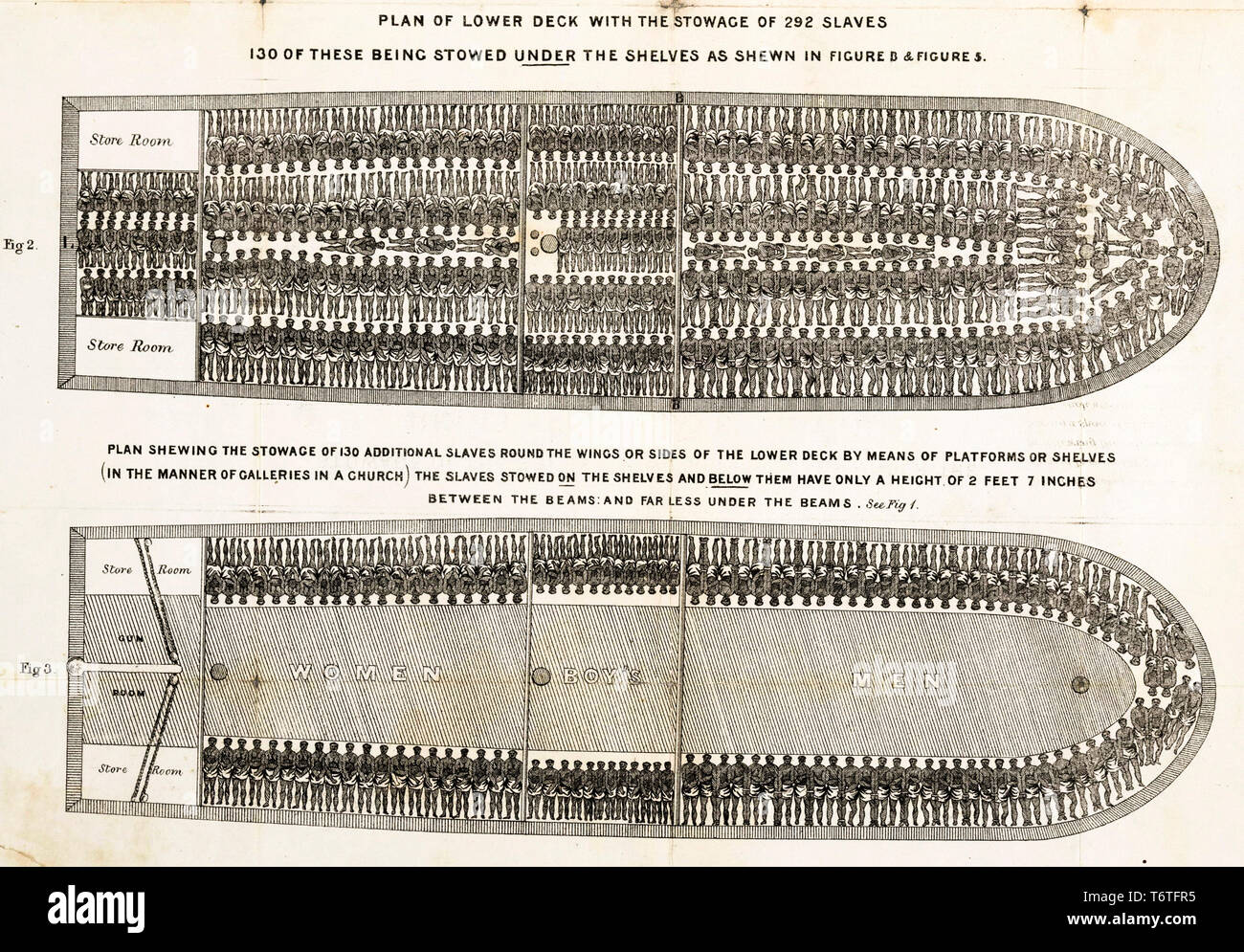
Stowage of the British slave ship Brookes, 1788. Library of Congress / Wikimedia Commons. Public domain.
Document C — Analysis Questions
Answer in your own words. Copying and pasting is disabled. 75-word limit per question.
Document D — Autobiography of a Formerly Enslaved Person
Olaudah Equiano, The Interesting Narrative of the Life of Olaudah Equiano (1789)
Who was Equiano? Olaudah Equiano described himself as born in West Africa. As a child, he was kidnapped and sold to European slave traders, eventually transported to Virginia. He later purchased his freedom, moved to England, and became a prominent voice in the British abolitionist movement. His autobiography, published in 1789, is one of the only surviving first-person accounts of the Middle Passage from the perspective of an enslaved person. Note: A historian has found evidence suggesting Equiano may have been born in South Carolina rather than West Africa — other historians dispute this. Even if his birthplace is uncertain, his account draws on the lived experiences of enslaved people and remains an essential historical document.
I was soon put down under the decks, and there I received such a smell in my nostrils as I had never experienced in my life: so that, with the loathsomeness of the stench, and crying together, I became so sick and low that I was not able to eat, nor had I the least desire to taste any thing. I now wished for the last friend, death, to relieve me; but soon, to my grief, two of the white men offered me food; and, on my refusing to eat, one of them held me fast by the hands, and laid me across I think the windlass, and tied my feet, while the other flogged me severely. I had never experienced any thing of this kind before. . . .
The crew used to watch us very closely who were not chained down to the decks, in case we would leap into the water: and I have seen some of these poor African prisoners most severely cut for attempting to do so, and hourly whipped for not eating. This indeed was often the case with myself. . . .
I feared I should be put to death, the white people looked and acted, as I thought, in so savage a manner; for I had never seen among any people such instances of brutal cruelty; and this not only shown towards us blacks, but also to some of the whites themselves. One white man in particular I saw, when we were permitted to be on deck, flogged so unmercifully with a large rope near the foremast, that he died . . . and they tossed him over the side. . . . This made me fear these people the more.
Source: Olaudah Equiano, The Interesting Narrative of the Life of Olaudah Equiano, 1789.
Document D — Reading Questions
Answer in your own words. Copying and pasting is disabled. 75-word limit per question.
Final Reflection
📝 Written Response
Answer the following question in a well-developed paragraph of 8–12 sentences. Draw on at least two of the four documents, and connect your answer to the data you gathered in class today using the SlaveVoyages database.
Which of the four documents (A, B, C, or D) do you consider the most reliable source of information about the Middle Passage? Explain your reasoning. In your answer, consider: who the author or creator was, what they had to gain or lose by representing conditions honestly, what details they include or leave out, and how the document compares to the others. Use specific evidence from the texts.
There is no single correct answer — different students may reach different conclusions. What matters is that your argument is grounded in evidence.
🔬 Group Research Project Connection
This assignment connects to your group research project. Complete the fields below to help you think about how today's primary sources relate to your lens and commodity.
How does the Middle Passage — or the labor system it represents — connect to your commodity and your analytical lens? This can be a note to yourself; it will not be graded as part of this homework but will be useful when you build your archive.