CASE
FILE
Colonial Tensions: Two Confrontations
A Unified Historical Investigation · Boston & Lexington, Massachusetts
Your Mission
You are a historical detective. In this investigation you will examine two separate confrontations between British soldiers and American colonists — one in Boston in 1770, and one in Lexington five years later.
For each event, your task is the same: examine the evidence and determine who was responsible for the violence. At the end, you will connect the two cases to answer a larger question about the coming of the American Revolution.
Setting the Scene: 1765–1775
Both confrontations emerged from a decade of rising tension between Britain and its American colonies. Before examining the evidence, review this timeline:
🔎 Warm-Up: Before You Begin
Captain Thomas Preston's Account
🔎 Sourcing — Answer BEFORE Reading
At about 9 some of the guards informed me that people were gathering to attack the troops. On my way there, I heard the crowd threaten the troops. About 100 people went towards the Custom House where the king's money is kept. They immediately surrounded the soldier there and threatened him. I was told that they were going to carry off the soldier and probably murder him. I immediately sent an officer and 12 men to protect both the soldier and the king's money. I followed them to prevent, if possible, any problems. I feared that the officer and soldiers might be provoked by the insults of the rioters. I told the troops to go out without loading their weapons and I never gave orders to load them.
The mob still increased, striking their clubs together, and calling out, "Come on you rascals, you bloody backs, you lobster scoundrels, fire if you dare." At this time I was between the soldiers and the mob, trying to persuade them to leave peacefully. Someone asked me if I was going to order the men to fire. I answered no, saying that I was in front of the guns, and would be shot if they fired. While I was speaking, one of the soldiers was hit with a stick, stepped a little to one side, and instantly fired. When I turned to ask him why he fired without orders, I was struck with a club on my arm.
The soldiers were attacked by a great number of heavy clubs and snowballs were thrown at them. All our lives were in danger. At the same time, someone from behind called out, "Damn your bloods — why don't you fire?" Instantly three or four of the soldiers fired and then three more fired in the same confusion. The mob then ran away, except three unhappy men who instantly died. When I asked the soldiers why they fired without orders, they said they heard the word fire and thought it came from me. My words were, don't fire, stop your firing.
📖 Close Reading
⚖️ Reliability
Samuel Drowne's Sworn Testimony
🔎 Sourcing — Answer BEFORE Reading
Samuel Drowne of Boston, of lawful age, testified that about nine o'clock of the evening of the fifth day of March he saw about 14 or 15 soldiers of the 29th regiment, some were armed with swords or bayonets, others with clubs or fire-shovels. They came upon the people of the town and abused some and violently assaulted others. Most of the townspeople did not even have a stick in their hands to defend themselves.
Most of the soldiers went to King Street. Drowne followed them, and saw them fighting with people there. Drowne thought that there were no more than a dozen people there. When the soldiers arrived, most of the people left. Some of them were first assaulted by the soldiers. Then the soldiers went towards the main guard house. At the same time, five soldiers and a corporal armed with guns came out of the guard house. By this time, there were two hundred people on King Street.
Drowne saw Captain Preston, whom he knew well, with a number of soldiers armed with guns near the Custom House. Drowne believed that most of the crowd left after seeing the armed soldiers. No more than twenty or thirty remained on King Street. Those who remained were mostly sailors and other persons who were poorly dressed.
Several of them dared the soldiers to fire. Drowne then heard Capt. Preston say to the soldiers, "Damn your bloods! Why don't you fire?" The soldiers did not listen and Preston immediately said "Fire." The soldiers fired randomly.
📖 Close Reading & Corroboration
⚖️ Reliability
Render Your Verdict: The Boston Massacre
You have examined two written accounts of March 5, 1770. Weigh the evidence and reach your conclusion.
⚖️ THE QUESTION FOR CASE I
What happened in Boston on March 5, 1770? Who was responsible?
🔍 Case I Analysis
From King Street to Lexington Green
You have just analyzed the Boston Massacre of March 5, 1770. Now you will investigate a second confrontation — one that took place five years later, eighteen miles away, and with far greater consequences.
The years between 1770 and 1775 did not bring peace. The Boston Massacre trial acquitted Captain Preston — a verdict that satisfied almost no one. Colonial resentment deepened. The Boston Tea Party of 1773, the Intolerable Acts of 1774, and the formation of colonial militias all brought the two sides closer to open war.
Five colonists killed on King Street, Boston. Preston acquitted. Tensions remain unresolved.
The Boston Tea Party: colonists dump British tea into Boston Harbor in protest of taxation.
The Intolerable Acts punish Massachusetts. Colonists form the First Continental Congress. Militias begin drilling.
British troops march to seize colonial arms at Concord. At dawn, they encounter militia on Lexington Green. A shot is fired. The Revolution begins.
🔗 Connecting Question
Examining the Scene: Image 1
Study this image carefully before answering the questions below. Do not look up anything about it yet.
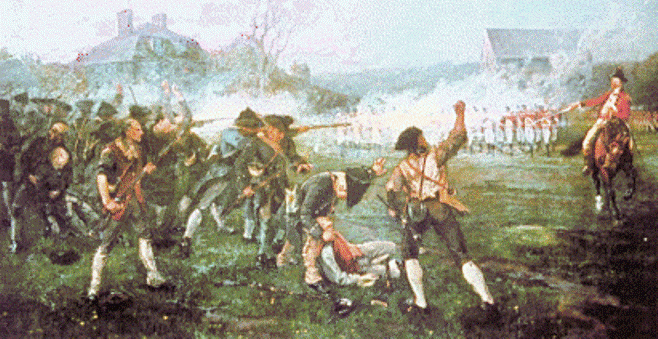
🖼️ Image 1 Analysis
Lieutenant John Barker's Diary
🔎 Sourcing — Answer BEFORE Reading
At 2 o'clock we began our march by wading through a very long stream up to our middles. About 5 miles away from a town called Lexington, we heard there were some hundreds of people collected together intending to oppose us.
At 5 o'clock we arrived there and saw a number of people, I believe between 200 and 300, formed in a common in the middle of the town. We still continued advancing, keeping prepared against an attack though without intending to attack them. As we came near them, they fired one or two shots, upon which our men without any orders, fired and put them to flight.
We then formed on the Common, but with some difficulty, the men were so wild they could hear no orders; we waited a considerable time there, and at length proceeded on our way to Concord.
📖 Close Reading
⚖️ Reliability Assessment
The 34 Minutemen's Sworn Testimony
🔎 Sourcing — Answer BEFORE Reading
We Nathaniel Mulliken, Philip Russell, [followed by the names of 32 other men present on Lexington Green on April 19, 1775] . . . all of lawful age, and inhabitants of Lexington . . . do testify and declare, that on the nineteenth of April, about five o'clock in the morning, we proceeded towards the Green, and saw a large body of troops marching towards us.
Some of our men were coming to the Green, and others had reached it, at which time, they began to disperse. While our backs were turned on the British troops, they fired on us, and a number of our men were instantly killed and wounded, not a gun was fired by any person in our company on the British soldiers to our knowledge before they fired on us, and continued firing until we had all made our escape.
📖 Close Reading & Corroboration
⚖️ Reliability Assessment
Render Your Verdict: The Battle of Lexington
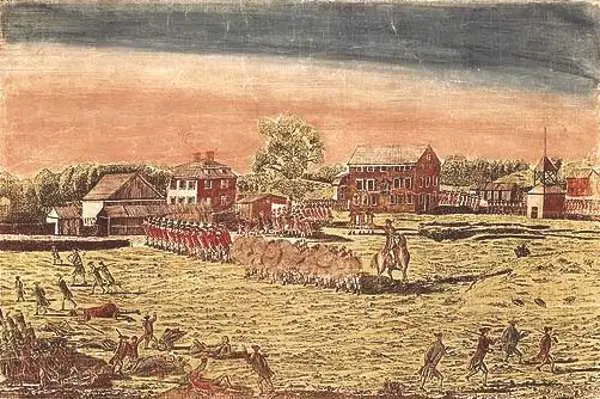
You have examined images and two written accounts of April 19, 1775. Weigh the evidence and reach your conclusion.
⚖️ THE QUESTION FOR CASE II
Who fired the first shot at the Battle of Lexington?
🔍 Case II Analysis
Putting It Together: Two Confrontations, One Revolution
You have now examined both confrontations as a historical detective. In 1770, five colonists were killed on King Street. In 1775, eight minutemen were killed on Lexington Green. The questions of who fired first — and who was responsible — were fiercely contested in both cases.
Now step back and look at the bigger picture. These were not isolated incidents. They were part of a fifteen-year conflict that ended in revolution. The final phase of this investigation asks you to connect the two cases and answer the overarching question of the entire unit.
The Overarching Questions
Use everything you have examined — four documents and two images across two confrontations — to answer these synthesis questions.
🔗 Patterns Across Both Cases
⚖️ The Big Picture
What Do Historians Say?
The Boston Massacre: Historical Consensus
- Most historians conclude the British soldiers did fire first — but that they were operating in a chaotic situation where the crowd was provoking and threatening them.
- Captain Preston was acquitted — defended successfully by John Adams, who argued Preston never gave a direct order to fire. The soldiers who fired were also largely acquitted.
- The term "massacre" was a political choice by colonists, notably Paul Revere, whose engraving became the defining image of the event. Historians note it was propaganda as much as reportage.
- Drowne's testimony and others like it were collected and organized deliberately to shape opinion in Britain and the colonies — a coordinated political campaign, not simply individual recollections.
The Battle of Lexington: Historical Consensus
- The "shot heard round the world" may have come from a bystander, a nervous soldier, or even a random accident — rather than a deliberate order on either side.
- Most evidence suggests the British fired the main volley — but the source of the very first shot remains genuinely disputed after 250 years.
- The colonists were vastly outnumbered. With militia facing British regulars, most historians consider deliberate first fire by the colonists unlikely.
- Barker's note that his men "could hear no orders" and were "wild" suggests the British volley may have been unordered — a chaotic moment that changed history.
The Pattern: A Revolution Built on Competing Narratives
In both 1770 and 1775, the historical record shows the same pattern: both sides immediately set about constructing their version of events for political audiences. The colonists were sophisticated and organized in this effort — from Paul Revere's famous engraving to the coordinated sworn testimonies. The British accounts were more ad hoc, written defensively by individuals protecting their reputations.
Historians today largely agree that by 1775, the structural conditions for revolution were already in place. Whether a nervous militiaman or a British soldier fired the first shot on Lexington Green may matter less than the fact that both sides were already operating in a framework where violent confrontation had become nearly inevitable. The question of "who fired first" — in both cases — was always as much a political question as a factual one.