Chronology: Germany 1789-1929
German States Before Unification
French Revolution
Revolutionary upheaval in France spreads liberal and nationalist ideas across Europe, including German-speaking territories.
Holy Roman Empire Dissolved
Napoleon Bonaparte dissolves the Holy Roman Empire of the German Nation, ending over 800 years of nominal German political unity.
Fichte's Addresses to the German Nation
Johann Gottlieb Fichte delivers nationalist speeches promoting German cultural unity and resistance to French occupation.
Napoleon's Defeat; Congress of Vienna; German Confederation
Napoleon is defeated. The Congress of Vienna reorganizes Europe and creates the German Confederation—a loose association of 39 German states dominated by Austria and Prussia.
Engels's Principles of Communism
Friedrich Engels publishes foundational Marxist text advocating proletarian revolution.
March Revolutions; Frankfurt Parliament
Liberal and nationalist revolutions sweep across German states. The Frankfurt Parliament attempts to create a unified German nation-state but fails.
Prussian Monarchists versus Liberals
Constitutional crisis in Prussia between liberal parliament and conservative monarchy over military reform.
Six Weeks' War; North German Confederation
Prussia defeats Austria, excluding Austria from German affairs. Prussia forms the North German Confederation under its leadership.
Austro-Hungarian Empire Formed
Austria reorganizes as a dual monarchy with Hungary, permanently separating from German unification.
German Reich (Kaiserreich)
Franco-Prussian War
Prussia leads German states to decisive victory over France. German nationalism surges.
Kaiserreich; Chancellor Otto von Bismarck
German unification: Wilhelm I of Prussia proclaimed Kaiser (Emperor) of Germany at Versailles. Otto von Bismarck becomes first Chancellor. Austria excluded.
Kulturkampf; Centre Party Formed
Bismarck launches "culture struggle" against Catholic Church. Catholics organize the Centre Party to defend their interests.
Social Democratic Party of Germany Formed
Marxist socialists unite to form the SPD, advocating for workers' rights and social democracy.
Anti-Socialist Laws
Bismarck bans SPD, closes socialist newspapers, prohibits socialist symbols. Simultaneously creates world's first social welfare system (pensions, health insurance, accident insurance) to co-opt workers.
Kaiser Wilhelm II
Young, impulsive Wilhelm II becomes Kaiser. Will dismiss Bismarck and pursue reckless foreign policy.
Bismarck Dismissed
Wilhelm II forces Bismarck to resign. Anti-Socialist Laws expire. SPD grows rapidly.
Pan-German League Formed
Radical nationalist organization promoting German expansion, antisemitism, and racial ideology.
World War I
Germany fights two-front war against France/Britain (west) and Russia (east). Initial Burgfrieden (civil truce) unites nation. War drags on. Starvation, exhaustion, military defeat. ~2 million German soldiers killed.
German Republic
Revolution and Republic
November 9: Kaiser Wilhelm II abdicates. SPD's Philipp Scheidemann proclaims German Republic. Communist Karl Liebknecht proclaims "Free Socialist Republic." Civil war threatens.
November 11: Armistice signed—Germany capitulates.
Spartacist Uprising; Bavarian Soviet Republic; Versailles Treaty; Weimar Constitution
January: Spartacist Uprising crushed by Freikorps. Rosa Luxemburg and Karl Liebknecht murdered.
Spring: Bavarian Soviet Republic declared in Munich, then brutally suppressed.
June 28: Treaty of Versailles signed. Germany loses 13% territory, 10% population. Reparations. Disarmament. War Guilt Clause. All parties denounce it as Diktat.
August 11: Weimar Constitution adopted—most democratic in the world.
Kapp Putsch; Ruhr Uprising; NSDAP's Twenty-Five Points
March: Right-wing Freikorps attempt coup (Kapp Putsch). General strike defeats it. Communist uprising in Ruhr brutally crushed.
February: NSDAP announces Twenty-Five Point program—antisemitic, anti-Versailles, authoritarian.
Matthias Erzberger (Centre) Assassinated
Right-wing terrorists murder Erzberger for signing armistice. Beginning of wave of political assassinations.
Treaty of Rapallo; Walther Rathenau (DDP) Assassinated; Ruhr Occupation
April: Germany and Soviet Union sign Treaty of Rapallo—secret military cooperation.
June: Foreign Minister Walther Rathenau assassinated by right-wing terrorists. Massive pro-democracy demonstrations. Law for Protection of the Republic passed.
December: Germany defaults on reparations.
Hyperinflation; Black Reichswehr Coup; KPD Hamburg Uprising; NSDAP Munich Putsch
January: France and Belgium occupy the Ruhr to seize reparations by force.
Throughout 1923: Hyperinflation crisis. Currency collapses. Loaf of bread costs 200 billion marks by November. Middle class wiped out.
October: KPD uprising in Hamburg crushed.
November 8-9: Hitler's Beer Hall Putsch in Munich fails. Hitler imprisoned (writes Mein Kampf).
Dawes Plan
American loans stabilize German economy. Reparations restructured. Recovery begins.
President von Hindenburg; Locarno Treaties; Germany in League of Nations
April: Paul von Hindenburg elected President—monarchist, anti-democratic, but swears to uphold constitution.
October: Locarno Treaties normalize relations with France/Belgium.
Germany Admitted to League of Nations
Germany regains international respectability under Foreign Minister Stresemann's leadership.
Kellogg-Briand Pact; First Naval Bill
May: Reichstag elections—SPD wins plurality. NSDAP nearly irrelevant (12 seats). Grand Coalition formed.
October: First armored cruiser ("pocket battleship") funded despite SPD opposition.
All Quiet; Red Front Banned; Young Plan; Wall Street Crash; Death of Stresemann
January: All Quiet on the Western Front published—international bestseller, ignites culture war.
May: SPD bans Communist Red Front paramilitary after May Day violence.
October 3: Gustav Stresemann dies suddenly at age 51.
October 24: Wall Street crashes. American loans recalled. German recovery ends.
Late 1929: YOUR SIMULATION BEGINS—Grand Coalition debates Young Plan, austerity, Freedom Law. Democracy in crisis.
The World That Was: The Kaiserreich, 1871–1918
Before 1871, German-speaking Europe consisted of dozens—at times, hundreds—of sovereign entities. Most nominally came under the Holy Roman Empire of the German Nation until its dissolution in 1806, but that empire never included all of German-speaking Europe, never exerted a strong central identity, and always included non-Germans.
Consequently, the various German-speaking regions remained fiercely loyal to local identities. Divisions based on mutually unintelligible dialects, deep religious cleavages (Lutheran, Calvinist, Catholic, Jewish), differing regional traditions, and long-standing political-institutional distinctions between rival German states counteracted a common cultural bond. In short, a Prussian was no more a Bavarian than an American was an Englishman, and neither was politically German.
German Unification, 1871
Nonetheless, by the eighteenth century, and accelerating during the Napoleonic Wars, a period of frequently violent political consolidation began. Two German states—Austria and Prussia—came to dominate the numerous lesser states. In a complicated struggle, Prussia emerged the dominant power.
In 1871, following victory in the Franco-Prussian War, German princes called on King Wilhelm of Prussia to take up the imperial crown and rule as kaiser. The resulting Kaiserreich unified twenty-seven smaller German states under the Hohenzollern Prussian monarchy but excluded Habsburg Austria (not to mention the German-speaking Swiss cantons). Royal families from the smaller states, such as the Wittelsbach of Bavaria, kept their crowns but swore fealty to the Hohenzollern emperors.
Creating a National Identity: Jingoistic Chauvinism
The sudden creation of an entirely new political reality, unifying formerly sovereign entities with deep traditions, inevitably created tensions. With their deep particularism, especially in the Catholic Rhineland and Bavaria, many Germans resented being ruled from the Prussian capital, Berlin. As a compromise, the Kaiserreich left local matters largely in the hands of the constituent states.
However, to create national cohesion, the new state launched sustained campaigns to promote a strong national identity—an identity based on a jingoistic chauvinism that sought to rally Germans against enemies both external (France, United Kingdom, Russia) and internal (Jews, Catholics, socialists, Poles).
This nationalization effort, conducted through the schools, press, political and cultural organizations, and the military, met with considerable success, but not without alienating many Germans and producing an increasingly narrow and racialized view of German identity. Following broader trends in Europe and the Americas, most Germans came to integrate race consciousness into everyday life. The German race was defined loosely as including anyone who had a German-speaking ancestry that excluded Jews.
Pan-Germanism and Lebensraum
This idea evolved into pan-Germanism—the idea that all Germans should be integrated into a single nation-state, particularly German speakers in neighboring countries such as Austria-Hungary, Russia, and France. As it fused with Lebensraum ideas, the notion inevitably led to militarily expansionistic racial ideas since such a state would require annexation of those neighboring territories where these German speakers lived and the simultaneous expulsion of non-Germans.
Lebensraum was the social Darwinist völkisch idea that Germany must expand territorially to be a healthy and vigorous Volk; this included displacing groups judged racially inferior.
Indeed, pan-Germanist thinkers, especially those organized in the Pan-German League, adopted openly ethnocentric and racist ideologies:
- Antisemitism became a regular feature of public discourse
- Black Africans in Germany's colonies—their citizenship and even humanity became subjects of public debate, with efforts to exclude them and their children (especially mixed-race children)
- Slavic minorities (mostly Polish and Czech) in the East faced policies of Germanization to eradicate non-German culture, language, and settlement through "inner colonization"—removing non-ethnic German property owners and workers and replacing them with ethnic Germans
⚠️ Foundation for Genocide
These widespread ideas laid the basis for later genocide.
The Social Question: Workers vs. Bismarck
But the conservative monarchist Chancellor von Bismarck realized that nationalism alone would not hold together the new Kaiserreich. The rise of the Social Democratic Party (SPD) in the 1870s revealed that serious social and economic issues divided Germans along class lines. Urban workers, what Marxists called the proletariat, demanded better working and living conditions to alleviate their squalid circumstances.
Bismarck's Two-Pronged Strategy
To suppress the socialist movement, Bismarck employed:
1. Repression: The Anti-Socialist Laws (1878-1890) outlawed trade unions, closed socialist newspapers, prohibited the display of socialist symbols, and otherwise harassed members of the SPD.
2. Social Welfare: When repression failed, Bismarck launched the second prong—introducing old-age pensions, accident insurance, medical care, and unemployment insurance, all of which formed the basis of the modern European welfare state. He and German industrialists hoped that these paternalistic programs would bind workers to the state.
Result: Despite these efforts, Bismarck's plan to stop the growth of the SPD failed, and by 1912 it had become the largest party in Germany—indeed, the largest socialist party in the world.
The Kulturkampf: Catholics vs. Protestants
Additionally, Catholics, a one-third minority in the largely Protestant Kaiserreich, resisted efforts to subordinate their religious identity to secular nationalism, especially in education. Bismarck and most Protestants shared a deep suspicion that Catholics were actually more loyal to Rome than to Berlin.
The result was the Kulturkampf (culture struggle) launched by Bismarck—an anti-Catholic campaign that only led to the hardening and organizing of Catholic opposition, especially in the form of the Catholic Centre Party. Bismarck eventually dropped the Kulturkampf as counterproductive, and Catholic elites were steadily incorporated into the national elite. Lutheran chauvinism, however, continued to alienate most Catholics.
The Junkers: Agrarian Aristocracy
The Junker class alone retained unrivaled prestige. These Protestant aristocrats of eastern Prussia prided themselves on a deep sense of state service, most importantly in the military. In fact, the Imperial Army's active officer corps consisted almost exclusively of Junkers, and they infused everyday life with hypermilitarization and propagated the conviction that a state should resemble an army in its authoritarian and hierarchical structure.
Who Were the Junkers?
- Protestant landowning aristocratic elites of eastern Prussia
- Dominated state and military affairs
- Socially conservative, linked to state-affirming Protestantism
- Dedicated to economic interests of large landholders
- No friends of democracy
- Created a pervasive ethos of agrarian conservativism among the Kaiserreich's elite
Agrarian Idealism and Blut und Boden
Despite Junker resistance, the transition from an agrarian to an industrial society accelerated, undermining the complicated fabric of a pre-industrial social order. The link between an increasingly outdated agrarian world and political power meant that the Kaiserreich escalated its protectionist policies, most notably grain tariffs, to protect the Junker estates from international competition.
An ideological reaction to these challenges developed that fused Christianity and a romanticized idealization of the peasantry into a conservative, rural-centered worldview. This agrarian idealism touted the innate superiority of rural life as the source of true German virtue in express opposition to perceived urban decadence. It consciously pitted itself against urban values including secularism, atheistic proletarian Marxism, and liberal capitalism and its presumed agent, the Jewish moneylender.
Blut und Boden (Blood and Soil)
The concept of Blut und Boden linked racialized nationalism to agrarian idealism. It celebrated the relationship of a Volk to its land and placed a high value on the virtues of rural living. This included a growing awareness of the need to secure food production for Germany's growing population.
The goal was agrarian autarky (self-sufficiency in food) within the German racial community so that Germany could free itself from dependence on foreign imports and the global market.
But this only increased anxieties about the demographics of Germany's eastern borderlands. Slavs, especially Poles, were increasing while Germans were decreasing as a percentage of the population. Few German farms in the East could exist without Polish seasonal labor as Germany's rural youth migrated to the cities or abroad. These changes threatened to Slavicize the German East, to urbanize German youth, and to undermine the German military by weakening national food security and decreasing the relative number of ethnic German army recruits.
By playing on these fears, political agrarianism established itself as a major political force, linking an agrarian völkisch identity to a hostility to urban modernity (with a heavy dose of antisemitism).
Industrialization and the Middle Class
Yet Germany was changing, as the growth of the SPD indicated. After 1850, Germany rapidly industrialized, with particular strengths in coal, iron, chemicals, and railways. By 1913, the Kaiserreich had grown from forty-one million to sixty-eight million people. Much of this growth was in the cities. The Kaiserreich augmented these changes with heavy investment in technology and science, gaining more Nobel Prizes in science than the United Kingdom, France, Russia, and the United States combined. In 1914 it was the most militarily powerful, industrialized, scientifically advanced, and educated nation on the continent of Europe, with the United Kingdom its only serious rival.
Not surprisingly, the middle classes, driving most of the industrial advances, clamored for political inclusion. They organized in various liberal parties. Yet, for all their vigor, their dominant ideology of liberalism failed to achieve many of its goals. The traditional elites only grudgingly accorded the liberal middle classes access to power and status—access that usually came at the price of acknowledging traditional authority.
Consequently, protectionism applied to industry as well, despite the liberal belief in free markets; it cemented a pro-monarchy conservative-liberal alliance of "iron and rye." Despite a rich tradition of democratic and revolutionary activity, by the start of World War I the clear majority of liberals had linked their interests to the military, nation-state, and Junker class. And why not? Despite the internal tensions and compromises, the Kaiserreich had become a Great Power, boasting the world's strongest army, second-largest navy, and third-largest colonial empire.
The Road to World War I
Yet this confidence bordered on hubris. Nationalist rhetoric grew ever more histrionic, demanding new territories and colonies and openly looking for military adventures. After the removal of Bismarck in 1890, the young Kaiser Wilhelm II engaged in increasingly reckless foreign policies that left the Kaiserreich diplomatically isolated. When the great crisis of 1914 arrived, the German Empire had few allies.
In the World War (1914–18), Germany became the de facto head of the Central Powers (Germany, Austria-Hungary, Ottoman Empire, Bulgaria). Despite initial successes, plans for a quick victory in the West failed, and the war on the western front stalemated against the forces of the British Empire and France. The Allied naval blockade led to the feared food shortages, and Germany had to repeatedly send troops to bolster its allies on other fronts.
Nonetheless, Germany ultimately had great success on the eastern front against tsarist Russia, which collapsed in revolution under the strain. The new Bolshevik government in Russia ended involvement in the war, and Germany forced it to cede vast eastern territories in the Treaty of Brest-Litovsk in early 1918. However, the costs had been enormous, and few German reserves remained.
Further, the German declaration of unrestricted submarine warfare in early 1917, intended to strangle the British, failed. That declaration—along with the Zimmermann Telegram—brought the United States into the war, and its reserves of money, food, armaments, and soldiers tipped the balance.
The Home Front Collapses
Meanwhile, Germans had become war weary:
- The death toll mounted. The injured returned home to every village.
- Food shortages, caused by the conscription of farm laborers and the Allied naval blockade, led to food strikes and riots and starvation.
- The high command, under Field Marshall von Hindenburg and General Ludendorff since 1916, imposed a military dictatorship, enforcing rigid censorship and tightly regulating the economy.
Facing a looming defeat, they gambled on one last offensive in spring 1918 before the Americans could arrive in force and Germany starved. This failed. In September 1918, Ludendorff appeared before the Reichstag and noted that if there were not an immediate cessation of hostilities, the German army could collapse. By October 1918, the German armies were in full retreat, the Austro-Hungarian Empire and the Ottoman Empire had fragmented, and the German people had lost faith in their political system. The Kaiserreich was on its last legs.
Birth of the Republic, 1918–1919
The November Revolution
In October 1918, as the front dissolved, the kaiser and his advisers agreed in desperation to introduce a British-style parliamentary system, but events quickly overtook this belated effort.
Scheidemann's Proclamation of the Republic
Workers and soldiers! The four war years were horrible, gruesome the sacrifices the people had to make in property and blood. The unfortunate war is over. The killing is over. The consequences of the war, need and suffering, will burden us for many years. The defeat we strove so hard to avoid, under all circumstances, has come upon us.
The Kaiser has abdicated. He and his friends have disappeared; the people have won over all of them, in every field. Prince Max von Baden has handed over the office of Reich chancellor to Representative Ebert. Our friend will form a new government consisting of workers of all socialist parties.
The old and rotten, the monarchy has collapsed. The new may live. Long live the German Republic.
Two Competing Visions: Liberal Democracy vs. Soviet Revolution
But preexisting cleavages in the socialist movement came immediately to the fore. Karl Liebknecht, co-leader with Rosa Luxemburg of the new communist Spartacus League, declared a more radical Free Socialist Republic that same day at the royal residence in Berlin, to inaugurate a Soviet-style revolution:
The day of the revolution has come. … Peace has been concluded in this moment. The old has gone. The rule of the Hohenzollerns, who have resided in this palace for centuries, is over. In this very hour we proclaim the Free Socialist Republic of Germany … where there are no more servants, where every honest worker will receive his honest pay. The rule of capitalism, which has turned Europe into a cemetery, is broken.
The unexpected power vacuum and threat of Bolshevik-style revolution led a desperate von Baden to unilaterally transfer the chancellorship to Friedrich Ebert (leader of the SPD since 1913), who reluctantly accepted. Ebert had presciently preferred a more constitutional transfer, but in view of the mass support for radical reforms among the workers' councils, he hastily established a socialist coalition government called the Council of People's Deputies. Although the Berlin Workers' and Soldiers' Council confirmed the new government, the Spartacus League opposed it.
The Armistice
Despite the new government's dubious constitutionality, its representatives immediately signed an armistice on 11 November 1918 to prevent the total collapse of the army and occupation of German soil, effectively ending military operations. It was an unconditional German capitulation.
Meanwhile, Germany devolved into civil war. Ebert called on the army to put down a mutiny in Berlin in December. The ensuing street fighting left several dead and injured on both sides. Radical socialists, outraged by the perceived treachery of Ebert and the SPD, formed the German Communist Party (KPD), openly allied with the Bolsheviks, and took up arms against the new government.
Progressive Reforms (November 1918 - January 1919)
During this time, the Council of People's Deputies, under pressure from the nongovernmental workers' and soldiers' councils, issued numerous decrees advancing progressive social and political change:
- Eight-hour workday
- Labor reform
- Social welfare relief
- National health insurance
- Universal suffrage (including women)
- Abolished undemocratic public institutions
The Ebert-Groener Pact: A Faustian Bargain
To ensure that his fledgling government maintained control, Ebert made an agreement with the army, led by Ludendorff's successor general Wilhelm Groener. The Ebert-Groener Pact stipulated that the government would not reform the army so long as the army swore to protect the state.
For the Military
Despite their opposition to the new government, the military realized that the army had collapsed; they knew full well what had happened in Russia and wanted to prevent a repeat.
The pact ensured that the traditional officer class retained control.
For the Government
For the fledgling government, it guaranteed victory over the Far Left.
As an additional bonus, it assuaged concerns among the middle classes about how radical the revolution might be.
But radical socialists considered it a betrayal. The Far Right opposed it since it validated social-democratic and liberal power.
The Spartacist Uprising: Blood in Berlin
Regardless, the pact proved decisive. In January 1919 the Spartacus League began an insurrection in Berlin, the Spartacist Uprising. The army, allied with right-wing paramilitary Freikorps units, brutally suppressed the uprisings, culminating in the summary executions of Rosa Luxemburg and Karl Liebknecht.
The Fatal Rift: SPD vs. KPD
The SPD coalition had survived. But the SPD alliance with the military and Freikorps led to a lasting bitterness between the SPD and KPD.
Luxemburg and Liebknecht became martyrs for the Left—killed on the orders of the SPD—and future cooperation became difficult at best.
This division would haunt the Republic for its entire existence. The two largest working-class parties would spend more energy fighting each other than defending democracy.
In this volatile climate, elections held on 19 January 1919 created a provisional National Assembly, dominated by moderate parties. Charged with writing a democratic constitution, delegates removed themselves from Berlin, which was wracked by street fighting, and convened in the small city of Weimar, giving the future Republic its unofficial name.
Continued Violence: Munich and the Borderlands
Elsewhere, fighting continued. In Munich, radicals declared a Soviet republic, but once again, Freikorps units and remnants of the army intervened. The fall of the Munich Soviet Republic resulted in the growth of far-right death squads and a wider movement in Bavaria, including the NSDAP. In the eastern provinces, monarchist forces fought the Republic as well as Polish nationalists determined to expand their own nation at Germany's expense.
Burden from the War
The human costs of the war were so staggering that they had dramatic social, economic, and cultural consequences just as consequential as the political fallout. The scale of death and maiming was unprecedented and shocking to contemporaries.
The Human Toll
- ~2 million German soldiers killed (roughly 15% of the 13 million who served)
- Or, thinking in terms of military-age men: approximately 13% of all men born between 1880 and 1890 were killed
- Another 7 million wounded or captured
- In total: about 55% of Germans who served were either killed, wounded, or captured
- ~750,000 civilians died from malnutrition
- ~150,000 from war-related disease, especially the Spanish Influenza
Witnessing the deaths by artillery, machine guns, and gas in a climate of constant, nerve-wracking fear and hunger at the front also led to the mental collapse of many surviving soldiers. Though the phenomenon of post-traumatic stress disorder was not recognized as such, the trauma millions of veterans experienced was apparent after the war. Indeed, the works of Erich Maria Remarque and contemporaries described this hell and its consequences in vivid detail.
Social Consequences: Gender Conflict and War Victims
In and of itself, the demographic consequence threatened the Republic. Women entered the urban workforce, with their employment in factories with ten or more workers increasing by 52 percent. Many women became accustomed to their new control over disposable income and liberation from the home. Yet returning veterans expected their jobs back and an immediate return to prewar male-dominated gender norms. Competition for jobs only added to the gender conflicts of the 1920s, feeding a misogynistic climate.
Indeed, many young women had deferred marriage and family during the war, only to find that there was not only an absolute deficit of men but also a limited pool of men who were not physically or psychologically damaged. Disabled veterans, war widows, and war orphans needed and demanded state assistance to survive. Here, too, the numbers were staggering:
- 2.7 million disabled veterans
- 1,192,000 war orphans
- 533,000 widows
Almost all of these people would otherwise have been in their prime productive years. Instead, they had become a substantial financial burden for a generation.
The Republic's Impossible Task
The resulting social consequences constantly tore at the fabric of the Republic. There was a consensus that war victims were the responsibility of the state, but determining, institutionalizing, and financing the nature of that responsibility proved overwhelming. Politicians disagreed on every point:
- Who should manage the war-related welfare system—the Reich, the states, or private entities?
- How much compensation was appropriate for each claim?
- Should a petitioner's economic status play any role?
- What about long-term psychiatric consequences of shell shock (PTSD)?
The Reich Pension Court, established to process claims, was soon overwhelmed. The failure to adequately provide for war victims (veterans, widows, and orphans) led to acrimonious recriminations, but every effort to create a unified movement foundered on the political factionalism of the Republic. As in every other aspect of the Republic, war victims organized in their political silos, creating separate socialist, communist, and nationalist organizations frequently working at cross-purposes.
Cultural Consequences: A Nation in Mourning—But Divided
German culture inevitably bent to the horror of mass death and the climate of bitterness—a climate exacerbated by the sense of defeat (a defeat for which the population had been wholly unprepared, based on blindly optimistic wartime propaganda) and the moral onus of guilt laid on Germany by the Allies.
The dark themes of German Expressionism, typified by the graphic, war-obsessed works of painters such as Otto Dix and movies such as The Cabinet of Dr. Caligari, set the new tone. The political divisions in Germany meant that the Republic failed to create a unifying and healing culture of national mourning and remembrance. Instead, such efforts were again either localized or politicized.
The Tannenberg Memorial (1927): Politicized Mourning
The dedication of the Tannenberg National Memorial in 1927—an event meant to honor unknown soldiers—exemplified how political factions co-opted even national monuments:
- Reich president von Hindenburg deliberately appeared in his imperial uniform rather than that of the Republic
- Members of the national conservative Stahlhelm paramilitary lined the road for ten kilometers—also wearing uniforms of the Kaiserreich
- In his speech, von Hindenburg used the occasion to defend the absolute sanctity of the Reichswehr, scandalizing world opinion by denying any German responsibility for the war
[Germany entered the war as] the means of self-assertion against a world full of enemies. Pure in heart we set off to the defense of the fatherland and with clean hands the German army carried the sword. Germany is prepared to prove this before impartial judges at any time.
Rather than providing a moment of national mourning and the creation of a new national ritual, the event only further divided Germans, stoking revanchist sentiments among conservatives and alienation among liberals and Marxists.
Economic Catastrophe
In the meantime, Germany faced an economic catastrophe:
- World demand for exports dropped after the war
- Loss of raw materials and foodstuffs from occupied territories and colonies disrupted supply chains
- The financial system and currency were in shambles due in large part to the profligate issue of war bonds
- Inflation eroded savings, and war bonds, in which many patriotic Germans had invested their life savings, were valueless
- The centralized war economy created serious distortions in distribution, production, and compensation that were not quickly repaired
- The United Kingdom continued its blockade well into 1919 to ensure that Germany signed the peace treaty
- The labor market suffered as veterans were no longer emotionally or physically fit for the workplace
The Treaty of Versailles: The Diktat
In these conditions, with no ability to resist militarily, the German peace delegation was powerless to revise the Allies' demands in the Treaty of Versailles in the spring of 1919. The treaty demanded German disarmament, substantial territorial concessions, and reparations. It also insisted that Germany accept full responsibility for the war in Article 231, the so-called War Guilt Clause.
Article 231: The War Guilt Clause
Almost every German perceived this as the deepest insult because it placed a moral onus on Germans and implied that their sacrifices not only had been in vain but also had been immoral.
To reinforce the accusation of criminality, an additional article charged Kaiser Wilhelm II with "supreme offense[s] against international morality and the sanctity of treaties," demanding that "the Government of the Netherlands surrender to them of the ex-Emperor in order that he may be put on trial." Other articles noted the right of the Allies to set up military tribunals for people believed to have committed war crimes.
Reparations
The War Guilt Clause had been included largely as a formal justification for reparations—payments for war-related damages. Reparations were a regular part of such treaties. In fact, Germany had included them in its treaties with Austria in 1866, France in 1871, and, most recently, in a final arrangement with Soviet Russia in August 1918. So it was not surprising that the Treaty of Versailles included reparations.
Indeed, the reparations bill was determined only in 1921 and was based on Germany's capacity to pay, not on Allied claims. In the interim, Germany was required to pay only for Allied occupation costs. All things considered, the burden was designed not to be debilitating, yet some voices even outside of Germany warned that reparations would undermine not only the new Republic but also long-term international relations.
Demilitarization
Given the cultural identity of the Kaiserreich, with its Prussian military prestige, the demilitarization clauses of the treaty were particularly shocking. Versailles comprehensively restricted the German armed forces. The provisions were intended to eliminate offensive capability but also to encourage international disarmament. While international disarmament failed to happen, Germany had little choice but to disarm itself, leading to persistent complaints that the real goal of Versailles was to leave Germany permanently open to invasion and extortion by France.
Military Restrictions
- Demobilization to no more than 100,000 men
- Abolition of conscription
- Dissolution of the general staff
- Limitation of military schools for officer training
- Complete demilitarization of the Rhineland, including demolition of border fortifications
- Prohibition of arms trade, stockpiles, and manufacture of chemical weapons, armored cars, and tanks
- Navy reduced to meager coastal defense force
- Air force entirely disbanded
Territorial Losses
Violating Germans' broad sense of national identity to include all German speakers, Versailles then imposed significant territorial and population losses. All combined, Germany surrendered 25,000 square miles and 7 million people in Europe. The surrender of Western Prussia, Posen, and Upper Silesia to the new state of Poland alone left almost a million German speakers inside Poland. Though Versailles regulated and guaranteed their rights, they, like German speakers in all the other annexed territories, were denied self-determination and subject to the annexing nations' legal right to "liquidate" German property.
In addition, while the Kaiserreich had held the third-largest colonial empire (after the United Kingdom and France), it was forced to surrender all of its overseas colonies.
German Reaction: "This Treaty Is Unacceptable"
When the full severity of the treaty and the exclusion of German representatives as negotiating partners became apparent, the National Assembly's initial reaction was to appeal to the Allies' sense of fairness based on international precedents. Foreign Minister Brockdorff-Rantzau wrote an eloquent but futile "Protest" to French premier Clemenceau. He accepted German defeat and the inevitable concessions but balked at the unrestrained nature of Allied revanchism:
We were aghast when we read … the demands made upon us, the victorious violence of our enemies. The more deeply we penetrate into the spirit of this treaty, the more convinced we become of the impossibility of carrying it out. The exactions of this treaty are more than the German people can bear.
Germany's first democratically elected chancellor, Philipp Scheidemann (SPD), resigned rather than sign the treaty. In a passionate speech before the National Assembly, he called the treaty a "murderous plan" and exclaimed, "Which hand, trying to put us in chains like these, would not wither? The treaty is unacceptable."
But Germany had no choice—a state of civil war existed, the military had collapsed, and people were starving. When President Ebert asked von Hindenburg if the army were capable of any meaningful resistance, he responded by having his chief of staff, General Groener, cable that the military position was untenable. Only after receiving this assessment did the National Assembly ratify the treaty. But every German political party denounced the treaty as a Diktat.
Erfüllungspolitik (Policy of Fulfillment)
The socialists, the Centre Party, and the liberals agreed that the only way to move forward from irretrievable defeat was to play for time and gradually erode Versailles with concessions.
They pragmatically adopted Erfüllungspolitik and used every opportunity to try to persuade the victors to diminish, amend, and eventually nullify the treaty.
Katastrophenpolitik (Policy of Catastrophe)
The DNVP, the NSDAP, and most of the Reichswehr denounced any compliance with Versailles as treason and labeled those willing to submit as the "November criminals."
They advanced a confrontational Katastrophenpolitik and used every opportunity to encourage noncompliance and resistance. This policy resulted in the disasters of the early 1920s, including the French occupation of the Ruhr, crippling hyperinflation, numerous uprisings, street battles, and assassinations.
Right-wing terrorists murdered hundreds of moderate leaders associated with Erfüllungspolitik.
The Stab-in-the-Back Myth
The German right created a powerful myth: Germany had not been defeated on the battlefield—it had been "stabbed in the back" by traitors at home (Jews, Socialists, Communists). General Ludendorff testified to this effect before a Reichstag committee in 1919.
This was a lie. Germany's military situation in October 1918 was hopeless. Ludendorff himself had demanded an armistice. But the myth allowed nationalists to blame the Republic for the defeat and the Versailles "shame."
Despite the divisions, almost every German agreed that Germany had been falsely blamed for the war. Indeed, no German government accepted the Treaty of Versailles as legitimate. Government officials openly rejected Germany's post-Versailles borders. In 1925, Foreign Minister Stresemann declared that the reincorporation of territories lost to Poland was his major task. A Reichswehr memorandum of 1926 declared the intention to reincorporate this territory as its first priority, to be followed by the return of the Saar territory, the annexation of Austria, and remilitarization of the Rhineland. Far from resolving issues, the war and treaty had only exacerbated them.
Years of Crisis, Reform, and Resurgence, 1919–1929
The Weimar Constitution (August 1919)
Although the National Assembly had to deal with numerous pressing issues, its primary task was the creation of a new constitution. The liberal politician Hugo Preuss (DDP) gave the first draft a decidedly democratic liberal framework. Although disagreements arose over issues such as the national flag, religious education, and the rights of the states, these were resolved by August 1919. The constitution passed overwhelmingly (262 to 75), but many deputies abstained, and members from conservative parties (DNVP and DVP) and the left wing of the SPD opposed it, revealing the fault lines that would plague the Republic. As the Republic's first president, Ebert signed the new constitution into law on 11 August 1919.
The Weimar Constitution: The Most Democratic in the World
Key Features:
- Universal Suffrage: All citizens 20+ could vote (including women—one of the first countries to do so)
- Proportional Representation: Reichstag seats allocated by percentage of vote (no minimum threshold)
- Bill of Rights: Articles 109-165 guaranteed civil liberties, religious freedom, property rights
- Federal System: 17 states (Länder) with their own governments; Prussia contained 60% of Germany's population
The Presidency:
- Directly elected for 7-year term
- Commander-in-chief of armed forces
- Appoints/dismisses chancellor
- Article 48: Can rule by emergency decree if "public order and security are seriously disturbed"
- Article 25: Can dissolve Reichstag and call new elections (once per issue)
The Fatal Flaw: Article 48
The constitution gave the president dictatorial powers "in emergencies"—but who defines an emergency? Article 48 was meant to be temporary, but the Reichstag could only override it by majority vote. As you will see, this became the mechanism for democracy's destruction.
As a whole, the constitution enshrined the values of liberal democracy. It was arguably the most progressive constitution in the world at the time. In the first elections, held on 6 June 1920, pro-Republic parties obtained a solid 80 percent of the vote, with the socialist parties achieving 45 percent. Led by Scheidemann, they created and led the first cabinet in the Weimar Coalition (SPD, Centre Party, and DDP).
Despite this solid base of support, several factors led to unexpected problems:
- The allocation of presidential powers was deeply problematic. The government structure deliberately mixed presidential and parliamentary systems, with the president acting as a replacement kaiser
- The proportional electoral system allowed a wide diversity of views. However, the lack of minimum thresholds to win representation facilitated the rise of splinter parties. It was possible to win a seat in the chamber with as little as 0.4 percent of the vote
The historian Richard J. Evans concluded:
All in all, Weimar's constitution was no worse than the constitutions of most other countries in the 1920s, and a good deal more democratic than many. Its more problematical provisions might not have mattered so much had the circumstances been different. But the fatal lack of legitimacy from which the Republic suffered magnified the constitution's faults many times over.
Confronting Political Violence
Given the context, the birth of the Republic failed to unify Germans. Instead, an extreme nationalist movement emerged that repeatedly blamed the Republic for leading to defeat, revolution, and humiliation. Meanwhile, the radical Left accused the ruling coalition of having betrayed the workers' movement and being a mere prop for the militarists and capitalists. Both agreed that the Republic must be destroyed, and they launched numerous uprisings while simultaneously attacking each other.
Yet the government, assured of the support of the military through the Ebert-Groener Pact, dealt severely and successfully with the occasional outbreaks of violence even as the army and its Freikorps allies committed hundreds of acts of gratuitous violence against workers and leftists.
This further alienated the KPD, which saw the Republic's action as additional evidence that the SPD had betrayed the ideals of the revolution. The success of the Freikorps at destroying the Bavarian Soviet Republic only encouraged the antidemocratic Right to use violence to seize power.
The Black Reichswehr
In addition, the military itself initially operated an extralegal covert wing, the so-called Black Reichswehr. It funneled money, arms, uniforms, and leadership to various paramilitaries operating in Germany and in the numerous border wars after the war. These units were occasionally thinly disguised as labor battalions, and its members worked fluidly with paramilitaries aligned with the NSDAP and DNVP and others. They engaged in acts of sabotage against the French occupation and carried out assassinations.
Consequently, right-wing death squads acted with impunity—shielded by the military and repeatedly absolved of wrongdoing by the courts. Assassinations of alleged November criminals became common. Hundreds of political assassinations occurred—almost all committed by right-wing activists. The judiciary, comprised almost exclusively of conservative holdovers from the Kaiserreich, issued sentences that revealed extraordinary leniency toward right-wing assassins and a corresponding severity against the few leftists who engaged in political violence:
Judicial Sentencing for Assassinations (1919-1922)
| Political Orientation | Murders | Convictions | Average Sentence |
|---|---|---|---|
| Left-Wing | 22 | 17 | 15 years |
| Right-Wing | 354 | 1 | 4 months |
The judiciary's bias was unmistakable. Right-wing terrorists murdered with near-impunity.
The Kapp Putsch (March 1920)
In this climate, on 13 March 1920, twelve thousand Freikorps soldiers occupied Berlin and installed Wolfgang Kapp (a right-wing journalist) as chancellor. The national government fled to Stuttgart and called for a general strike against the putsch.
The strike meant that no official pronouncements could be published, and, with the civil service out on strike, the Kapp Putsch collapsed after only four days, on 17 March.
Inspired by the general strike, a workers' uprising began in the Ruhr region when fifty thousand people formed the Red Army and took control of the province. The workers, who were campaigning for an extension of the plans to nationalize major industries, supported the national government, but the SPD leaders in the government did not want to lend support to the left wing of the SPD or KPD, which favored the establishment of a socialist regime.
As a result, the regular army and the Freikorps ended the uprising on their own authority—without receiving any formal authorization from the government, but with clear consent from the right wing of the SPD leadership. The repression of an uprising of socialist supporters by the Freikorps on the instructions of SPD ministers repeated the pattern of the Ebert-Groener Pact and became a further source of conflict within the socialist-communist movements, contributing to the weakening and fracturing of the largest bloc that supported the young Republic.
The Assassination of Walther Rathenau (1922)
Despite such instances of left-wing political violence, terrorism and insurrections remained largely the purview of the Right after 1919. One example of the link of right-wing terror to political events came with the Treaty of Rapallo. In 1922, the Reichswehr and civilian leaders, in an attempt to subvert the military restrictions of Versailles, signed the Treaty of Rapallo with the Soviet Union, which allowed Germany to train military personnel in the USSR in exchange for military technology.
While the Reichswehr leadership supported the treaty, it forced Germany to publicly renounce territorial claims against the USSR. As a result, two extremist junior army officers assassinated foreign minister Walther Rathenau (DDP). He was also targeted because he was part of the delegation that signed the Versailles Treaty. In addition, he was a Jew.
The assassins were members of the right-wing terrorist group Organization Consul, which had carried out numerous assassinations. They believed Rathenau's death would bring down the government by prompting the radical Left to take revolutionary action. They hoped to use this as an opportunity to establish an authoritarian regime or a military dictatorship with the aid of the Reichswehr.
The terrorists' aims were not achieved, however, and civil war did not come. Instead, millions of Germans gathered on the streets to express their grief and to demonstrate against counterrevolutionary terrorism. When the news of Rathenau's death became known in the Reichstag, the session fell into turmoil. Karl Helfferich (DNVP) in particular became the target of criticism because he had just recently made a vitriolic speech against Rathenau.
Law for the Protection of the Republic (1922)
The assassination finally energized Republican authorities to act decisively to stabilize the Republic, and the Reichstag passed the Law for the Protection of the Republic, which:
- Increased the penalties for attacks on Republican institutions and officials
- Established a special court to handle anticonstitutional actions
- Laid down regulations for the strict control of associations, meetings, and printed matter
Only the DNVP, the Bavarian People's Party, the Communists, and some members of the liberal DVP voted against it. Bavarian representatives considered the law a gross overreach by Berlin, and the KPD feared that it would inevitably be used against them (as it was). But conservatives opposed the express political intent of the law to stop the Right.
During the official memorial service for Rathenau, Chancellor Wirth (Centre) had admitted as much when he called out:
There stands the enemy who drips his poison in the wounds of the nation. There stands the enemy; and there can be no doubt about it: this enemy stands on the right.
The Beer Hall Putsch (November 1923)
The shift toward ending political violence was not immediately effective, however. In 1923, the small, local NSDAP under Adolf Hitler in Munich launched the Beer Hall Putsch (aka the Munich Putsch). On 8 November 1923, in a pact with Ludendorff, the NSDAP took over a meeting of Prime Minister von Kahr of Bavaria at a beer hall. Ludendorff and Hitler declared that the Berlin government was deposed and that they were taking control of Munich.
Bavarian authorities, however, thwarted the three thousand insurrectionists. Hitler was arrested and sentenced to five years in prison for high treason. The sentence, though, was the minimum allowable under law. The same conservative judges, who routinely sentenced striking workers and communists to death or to life in prison for lesser offenses, again proved highly sympathetic to right-wing terrorists even though four police officers had been killed.
Hitler served less than eight months in a comfortable cell, receiving a daily stream of visitors before his early release in 1924. While in jail, Hitler dictated Mein Kampf (My Struggle), which laid out his ideas. During this time, Hitler also decided to focus on legal methods of gaining power.
Yet, overall, the reactions to Rathenau's assassination strengthened the Republic. For as long as the Republic existed, the date 24 June remained a day of public commemorations. In public memory, Rathenau's death increasingly was seen as a martyr-like sacrifice for democracy.
Stabilizing the Economy
The year 1923 was a year of hyperinflation as well as uprisings. Without stabilizing the economy, there was little hope of ending the violence. In the early postwar years, with the economy in shambles, inflation was already growing at an alarming rate, but the government simply printed more banknotes to pay the bills. As a result, the value of the German mark decreased tenfold between December 1918 and April 1920.
Yet in 1923, the government engaged in a high-risk attempt to convince the Allies to renegotiate reparations, launching a conscious policy of Katastrophenpolitik to simultaneously defy obligations under Versailles and deliberately sabotage the economy to convince the Allies of the treaty's unfairness. The consequences were, as intended, catastrophic.
The Hyperinflation Crisis of 1923
A new cabinet that excluded the SPD (the largest party) claimed it could no longer make reparations payments, and it defaulted by refusing to ship any more coal across the border. In response, French and Belgian troops occupied the industrial heartland of the Ruhr area inside Germany to compel the coal shipments.
This occupation outraged the German public. The government called for strikes and encouraged passive resistance, which lasted eight months. To keep up the strikes, the state paid striking workers. Yet, as tax revenues collapsed, and lacking any reserves, all the Republic could do was print more money, fueling hyperinflation. As inflation eroded currency value, workers demanded raises to keep up with inflation, while many businesses profited by simply paying off their debts with worthless currency.
The value of the mark collapsed:
- 1919: A loaf of bread cost 1 mark
- 1923: The same loaf of bread cost 100 billion marks
The state and economy were in free fall. The Allies would not renegotiate under pressure. Under these conditions, Stresemann created a new grand coalition that brought the SPD back. The coalition ended resistance, agreed to resume reparations, and introduced a new currency. As reparation payments resumed, the subsequent Locarno Treaties returned the Ruhr to Germany, but fears of hyperinflation lingered.
Katastrophenpolitik had failed abysmally.
Who Was Destroyed by Hyperinflation?
The middle class. Anyone who had savings, pensions, bonds, or loans was wiped out. Workers could demand higher wages. The rich owned real assets (land, factories). But the middle class—small business owners, retirees, professionals—lost everything.
This created a permanent wound in German society. The middle class would never trust the Republic again. Many would turn to Hitler.
Subsequent governments pointed to this abject failure to justify Erfüllungspolitik. Economic stability, they argued, led to political stability, which in turn would ultimately erode Versailles. But it was a long-term approach, and it required both patience and favorable economic conditions.
Social Reform
Despite the instability, the provisional governments carried out a wide range of progressive social reforms during and after the revolutionary period:
Progressive Reforms of the Weimar Republic
1919:
- Maximum 48-hour workweek
- Restrictions on night work
- Half-holiday on Saturday
- Break of 36 hours of continuous rest during the week
- Health insurance extended to wives and daughters without independent incomes
- Progressive tax reforms: taxes on capital and highest income brackets increased from 4% to 60%
- Aid for disabled veterans and their dependents administered by central government
- Nationwide network of state and district welfare bureaus for war widows and orphans
1922:
- National Youth Welfare Act: obliged all municipalities and states to set up offices for child protection and codified the right to education
- Rent regulation and increased protections for tenants
1920s:
- Health insurance coverage extended to seamen, people employed in education and social welfare, and all primary dependents
- 1924: Modern public relief program introduced
- 1925: Reform of accident insurance program allowing work-related diseases to become insurable risks
- 1927: National unemployment insurance program introduced
- Affordable state-funded housing construction accelerated: over 2 million new homes constructed from 1924, another 195,000 modernized
But Problems Lurked Under the Surface
By 1929, unemployment had crept up to 10 percent, and unemployed workers were expected to survive on state support of 849 RM per year. Even for the employed, real wages reached the level of the prewar era only in 1928. The average monthly pay was between 100 and 250 RM, with an expectation for the majority of workers that they work more than forty-eight hours per week. By no German standard were these wages above the poverty level. Indeed, as a reflection of chronic poverty, doctors estimated that 30 percent of youth were malnourished.
Golden Era, 1924–1929
For all the turmoil, after the crisis year of 1923, Germany recovered—indeed, it thrived by many estimates. Stresemann, who served as foreign minister from 1923 to 1929, embodied to the world a renewed Germany, steadily reclaiming its position in world affairs. His tenure marked a period of relative stability for the Republic, known as the Golden Twenties. Prominent features of this period were a growing economy and a consequent decrease in civil unrest; political assassination and insurrection all but disappeared.
Restoring civil stability and stabilizing the currency promoted confidence in the German economy and helped the recovery so ardently needed for the German nation to keep up with reparation repayments, while at the same time feeding and supplying the nation.
The Dawes Plan (1924)
In one way, even the hyperinflation had helped. Following the Ruhr Crisis of 1923, the Allied Reparations Commission asked the U.S. expert Charles Dawes to find a quick solution to reparations. Within months, the Dawes Commission developed the Dawes Plan (1924) that allowed U.S. banks to lend money to German banks, with German assets as collateral, to help pay reparations.
The German railways, the National Bank, and many industries were mortgaged as securities for the currency and the loans. Once in place, the economy rebounded and the Republic continued with the payment of reparations with the influx of American capital.
Shortly after, the French and Germans agreed that the borders between their countries would not be changed by force, but left open the prospect of negotiated changes. Other foreign policy achievements included the evacuation of the Ruhr and improved relations between the Soviet Union and Germany. In 1926, Germany was admitted to the League of Nations as a permanent member. Meanwhile, trade increased and unemployment fell. Indeed, for the first time, a government remained in power for its full term (1924–28).
Cultural Renaissance
In this context, the 1920s saw a remarkable cultural renaissance.
German artists, especially in cosmopolitan Berlin, looked to contemporary progressive cultural movements such as impressionism, expressionism, and cubism coming from Paris as well as radical artistic innovations emanating from the Soviet Union. They often condemned the excesses of capitalism and demanded revolutionary cultural changes. German literature, cinema, theater, and music entered a period of great creativity as innovative street theater brought plays to the public, and the cabaret scene and jazz became wildly popular. Many new buildings followed the straight-lined, geometrical style being popularized in the United States. Examples of the new architecture included the Bauhaus Building, the Grosses Schauspielhaus, and the Einstein Tower.
Conservative Backlash
But not everyone was happy with the cultural changes taking place. Conservatives and reactionaries feared that Germans were betraying traditional values by adopting popular styles from abroad, particularly those popularized by Hollywood and the New York fashion scene.
For instance, the euphoria surrounding the African American dancer Josephine Baker in the metropolis of Berlin, where she was declared an "erotic goddess" and greatly admired, led to condemnations of Americanization, with explicit negative references to the degeneracy of "negrification" and Jewish influences.
Not surprisingly, many artists such as George Grosz regularly faced lawsuits and fines for defaming the military and for blasphemy. The new modes also stirred up patriarchal resentments. Many feared that modern young women were being either liberated or masculinized, or both, by wearing makeup, cutting their hair short, smoking, and breaking with traditional mores.
Foreign Relations
Reparations: The Dawes Plan and the Young Plan
The Reichstag considered the Dawes Plan a temporary measure and expected a future revision. In 1928, Foreign Minister Stresemann called for this final plan. The ensuing Young Plan of 1929 proposed additional payment reductions and early evacuation of the Rhineland by France in 1930, five years ahead of schedule. Almost all observers, including the Allies and German cabinet, saw the Young Plan as yet another dramatic foreign policy success of Erfüllungspolitik.
The Far Right's Response: The Freedom Law
Yet the Far Right was desperate to find an issue to recover the support it had lost in the 1928 elections. Political violence was counterproductive; the economy was growing; the government had scored numerous foreign policy successes; and the SPD-led coalition was contentious but stable. The Right turned to lingering resentment over the Treaty of Versailles.
In response to the Young Plan, the DNVP, in coalition with ultranationalist groups, actively encouraged a return to the Katastrophenpolitik of 1923 by openly defying the requirements of the Versailles Treaty. They sponsored the so-called Law against the Enslavement of the German People, or Freedom Law.
The bill not only renounced Versailles but also made it a criminal offense for any official to cooperate with the treaty.
What the Freedom Law Would Mean
The law would mean that the government was committing a criminal action if it recognized any portion of the Versailles Treaty—including:
- Making reparation payments
- Negotiating any aspect of the treaty
- Acknowledging international borders set by the treaty
Negotiating or supporting the Young Plan, for example, would have violated the Freedom Law.
The French and Belgians threatened that passing such a law would result in international intervention—including military force—to bring Germany into compliance.
The cabinet of Hermann Müller (SPD) made clear that they would not support the law or violate the treaty, and would instead continue with their Erfüllungspolitik, including ratification of the Young Plan:
The Government of the Reich, in agreement with the immense majority of the German people, knows that improvement in the external situation cannot be imposed by a German law. It can only be attained by negotiations with the associates of Germany.
Pushed by the Right, seeking to find a wedge issue after their electoral defeat in 1928, the Freedom Law and the Young Plan became the central intertwined political issues of late 1929.
Poland and the Eastern Border
Complicating matters, the cabinet was simultaneously seeking to resolve a number of issues with Poland. The creation of the Second Republic of Poland by the Treaty of Versailles infuriated nationalists. Poland annexed significant German territories, including the Polish Corridor, a region that separated East Prussia from the rest of Germany.
Poles successfully argued that access to the Baltic Sea via the port of Danzig was essential for the otherwise landlocked Poland. For Germans, this territorial redrawing:
- Reduced the size of Germany
- Created an isolated and militarily indefensible exclave (East Prussia)
- Abandoned hundreds of thousands of German nationals in a foreign and hostile state
- Severed a centuries-old claim to land in the East considered historically German
Yet the American diplomat David Hunter Miller dismissively concluded, "The Corridor and Danzig should be ceded to Poland. … In the case of Poland they are vital interests; in the case of Germany, aside from Prussian sentiment, they are quite secondary."
The German Refugee Crisis
Already facing an agrarian depopulation crisis, especially acute in the East, since the nineteenth century, Germans regarded these border changes as deliberately calculated to economically, militarily, and racially weaken Germany. Polish and German nationalists immediately attempted to change the facts on the ground, starting with a series of small-scale but bloody border wars after 1918.
Without a standing army, Germany relied on right-wing paramilitaries, which remained a problem even after the wars ended. Yet, Poland prevailed against these militias and annexed the promised province, resulting in a mass exodus of German speakers (encouraged by the Polish state).
The refugees put constant pressure on the successive cabinets of the Republic to address the Polish Question. Indeed, although Stresemann's foreign policy made conciliatory gestures toward the West, his attitude toward Poland remained hostile. Not a single German party accepted the Polish annexations. No German cabinet offered any guarantees about Germany's eastern frontiers.
The Trade War with Poland
Lacking an army, the cabinet developed a plan to wreck Poland's economy and gain political concessions via a trade war. Even the free-trade, liberal DDP-leaning newspaper the Frankfurter Zeitung (Frankfurt Newspaper) wrote in 1924:
Poland must be mortally wounded after the trade war. With her blood her strength will flow away as well, and finally her independence.
The economic consequences for Germany were minimal since only 3 to 4 percent of German trade was with Poland. Poland, on the other hand, suffered tremendously, since it had little choice but to trade with Germany. The trade war exacerbated the situation in Poland to such an extent that it helped lead to a coup in 1926 that placed the general Józef Piłsudski in charge of what was, in effect, a dictatorship.
Anti-German Actions in Poland
In retaliation, ethnic Germans faced escalating pressure from the local Polish population and officials. Germans traveling between East Prussia and the rest of Germany were regularly harassed by Polish nationalists. In May 1925 a train passing through the corridor on its way to East Prussia crashed due to apparent sabotage on the line: the spikes had been removed from the tracks for a short distance and the fishplates unbolted. Twenty-five people, including twelve women and two children, were killed; some thirty others were injured.
Land Liquidation and Forced Polonization
The Polish government retaliated by other means as well. Per Versailles, Poland could force ethnic Germans to choose between Polish or German citizenship. Poland was also authorized to liquidate the property of German nationals. Thus, Germans in Poland either had to accept Polish citizenship or face losing their land.
Consequently, in 1925 Poland began land reform, ostensibly to improve agricultural efficiency. The first annual list of properties to be reformed included:
- 10,800 hectares from thirty-two German landowners
- 950 hectares from seven Poles
In fact, the Polish governor of Pomorze stressed, "The part of Pomorze through which the so-called corridor runs must be cleansed of larger German holdings."
Thousands of complaints were issued to the International Court of the League of Nations about violations of German minority rights—to no avail. The result was a steady exodus of Germans and the rapid Polonization of West Prussia:
- 1910: Germans made up 40% of the population in the Polish Corridor
- 1921: That number had been cut in half to 18.8%
- By 1923: As many as 800,000 ethnic Germans had left
Though the reasons for the exodus were complicated, for most Germans the cause was clear—Poland's anti-German policy of forced assimilation.
The Liquidation Treaty (1929)
By 1929, however, Polish economic hardship and German inability to staunch the population losses led both sides to commit to a peaceful settlement, though both sides pointed out that any attempt to permanently revise borders would mean war.
To end the crisis, the German government began negotiating a treaty that would resolve these matters, the so-called Liquidation Treaty, and conceptually linked this treaty to certain provisions in the Young Plan—a linkage that made sense financially but only inflamed tensions politically.
⚠️ Why This Matters for the Simulation
The Polish Question is THE most explosive foreign policy issue. Every party—from Communists to Nazis—rejects the Polish Corridor. The debate over the Young Plan is inseparable from debates about Poland.
Can you accept a treaty that implicitly recognizes Polish borders? Can you negotiate with Poland while German refugees suffer? Can you risk war with France to reject Versailles?
Military Affairs
The Reichswehr: A State Within a State
The Treaty of Versailles and the revolution did not destroy most of Germany's traditional institutions, with the notable exception of the monarchy. The civil service, the schools and universities, the judiciary, and, most importantly, the military remained in the hands of the same men who ran them in the Kaiserreich. Most retained their conservative, authoritarian preferences.
After the dissolution of the imperial army in 1918, Germany's military forces consisted of the irregular Freikorps and a few regular units. The Freikorps were formally disbanded in 1920, though they continued to exist in underground groups, and on 1 January 1921 a new Reichswehr was created.
Advantages and Limitations
Advantage: One unintended advantage of the limitations of Versailles was that the Reichswehr could afford to pick the best recruits for service. It became an elite professional force.
Limitation: However, with inefficient armor and no air support, the Reichswehr had limited combat abilities.
However, for all its professionalism, the Reichswehr was, based on the Ebert-Groener Pact, a "state within a state," autonomous from the government and free from civilian oversight. There were rumors that the Reichswehr attempted to skirt the treaty in various ways—via secret budgets, money laundering, even training in the Soviet Union. That the Reichswehr was subverting international law was not a surprise.
The Reichswehr's Loyalty—Not to the Republic
Although technically in the service of the Republic, the army was predominantly officered by conservative reactionaries who were sympathetic to right-wing organizations, including terrorists. Hans von Seeckt, the head of the Reichswehr, declared that the army was not loyal to the Republic and would defend it only if it were in the military's interests.
During the Kapp Putsch in 1920, for example, the army refused to fire on the right-wing putschists. However, as right wing as the army was, it was hostile to the NSDAP, which it viewed as mostly thugs. Indeed, the Reichswehr considered the party's Sturmabteilung (SA) its main opponent. Regular officers saw the SA, which demanded the creation of a "people's army," as a threat to their existence. The army did not refrain from firing on the SA when it suppressed the NSDAP's unsuccessful Beer Hall Putsch in 1923.
The Reichswehr's officers were also utterly devoted to von Hindenburg, who, as Reich president, was the formal head of the Reichswehr and consistently defended its absolute sanctity. Yet it was general Kurt von Schleicher, as head of the Defense Ministry's Office of Ministerial Affairs that looked after the Reichswehr's political interests, who made day-to-day decisions.
It was unimaginable that the Reichswehr would act without, first, the consent of von Hindenburg, and, second, the coordination of von Schleicher. How they would act under a different president and defense minister, though, was unpredictable.
The Naval Question: Armored Cruisers
One of the debates confronting the Reichswehr involved the navy. The military proposed building three new Deutschland-class armored cruisers, derisively referred to as "pocket battleships" by the English press. Political opposition to the new ships was significant. The Reichswehr therefore decided to delay ordering the first ship until after the Reichstag elections in 1928, hoping for a conservative majority. The question over whether to build the new ships was a major issue in elections, particularly with the SPD, which campaigned with the slogan "Food for children, not armored cruisers."
The SPD's Dilemma
After the SPD victory in those elections, the issue posed a dilemma for the new SPD-led cabinet. Liberal parties, which were an integral part of the ruling coalition, made it clear they would bring down the government if it failed to fund the new ships. This position was supported by a majority in the Reichstag, so the SPD leadership reluctantly went along.
In October 1928, the KPD attempted to derail construction by calling a popular referendum against construction, but it failed.
International Response
The issue provoked an international response as well. When the Allies learned the particulars of the design, they attempted to prevent Germany from building the ships as a violation of Versailles. The Reichswehr offered to halt construction on the first ship in exchange for admittance to the Washington Treaty, which regulated naval size. This agreement would have effectively abrogated the clauses in Versailles that limited Germany's naval power.
The United Kingdom and the United States favored making concessions to Germany, but France refused. Since the ships seemingly did not violate the technical terms of the treaty, the Allies could not prevent Germany from building them after a negotiated settlement proved unattainable.
Yet, to continue building the ships, the Reichstag had to pass an annual naval funding bill, meaning that the divisive issue of guns or butter would resurface every year.
Paramilitary Violence
By 1929, the violent days of the early Republic had faded. Assassinations of leading politicians had ceased. No uprising had occurred since 1923. The Black Reichswehr and Freikorps had disbanded. The Reichswehr and Republic had achieved a modus vivendi. But threats lurked just below the surface. Street fights, especially between the rival paramilitaries of the NSDAP and KPD, often resulted in riots and death. Low-level state officials faced real threats of terror attacks. And most of the large parties continued to maintain paramilitary organizations of such size that they collectively dwarfed the Reichswehr.
The Major Paramilitaries (1929)
| Organization | Party Affiliation | Estimated Size | Status |
|---|---|---|---|
| Sturmabteilung (SA) | NSDAP | ~60,000 (growing) | Legal |
| Red Front (RFB) | KPD | ~130,000 | BANNED (May 1929) |
| Reichsbanner | SPD/Centre/DDP | ~3,000,000 | Legal |
| Stahlhelm | DNVP | ~500,000 | Legal |
| For comparison: The Reichswehr had only 100,000 men | |||
Well-organized paramilitaries were legal (provided they did not actively oppose the Republic), and members could wear uniforms and train openly. All were affiliated with a political direction, but they were not legally identified with a party. While this distinction had little real meaning, it did mean that political parties could not be held accountable for their paramilitaries' often unruly, frequently violent, occasionally murderous actions. For example, the Red Front was banned, but not the KPD.
The fact that these paramilitaries waged street fights meant that many people believed they should be banned—if not all of them, then at least those that engaged in clearly documented violence. Unless specified otherwise, the bans were for one year but could be renewed.
The NSDAP's "Legality Strategy"
The government, using the 1922 Law for the Protection of the Republic, made some attempts to ban either the NSDAP or the SA. This happened in 1923 after the Munich Putsch, but it only increased that party's popularity and the ban was soon lifted. Most agreed that a ban on a party violated the essence of constitutional democracy. The Supreme Court indicated that a party ban would be constitutional only in the context of a direct threat (an actual insurrection by a party).
Upon Hitler's release from prison in 1924, he convinced the Bavarian authorities to lift the ban on the NSDAP and reformed the party under his undisputed leadership. The new party was no longer a paramilitary organization, and it officially disavowed any intention of taking power by force. The party and the SA were kept separate and the legal aspect of the NSDAP's work was emphasized. In a sign of this change, the NSDAP admitted women.
In all public statements, the official stance of the NSDAP was the new Legality Strategy—a shift away from attempting to seize power through violence and towards electoralism. However, the street actions by the SA and incriminating evidence found in a police raid on a Nazi lawyer's office made many wonder if the NSDAP was sincere. Indeed, the NSDAP was repeatedly hauled into court to address the violence of the SA. In these courtroom exchanges, state's attorneys attempted to get Hitler to incriminate the NSDAP as supporting violence against the Republic, which would allow the state to use the Law for the Protection of the Republic to ban the NSDAP. Hitler generally deftly parried each attempt without disavowing the party's revolutionary goals, and conservative judges revealed their political sympathies for anti-Republican nationalists.
The Banning of the Red Front (May 1929)
In May 1929, the SPD interior minister used the Law for the Protection of the Republic against the Left and banned the Red Front, the KPD's paramilitary. This action was precipitated by the involvement of the Red Front in protests after the government of Berlin, which was controlled by an SPD-led coalition, banned celebrations of International Workers' Day (1 May). Police, led by the SPD chief of police, shot and killed more than thirty demonstrators.
Not only was the Red Front banned, but all its assets were confiscated by the government. Furthermore, all attempts at creating successor organizations were banned. Even the SPD agreed with the Right that the greater threat came from the KPD, not the NSDAP.
⚠️ Why This Matters for the Simulation
The paramilitary question is inseparable from all other issues:
- Should ALL paramilitaries be banned? Or just the violent ones?
- Is the Red Front ban hypocritical since the SA remains legal?
- Does banning paramilitaries violate freedom of association?
- Will the Reichswehr support banning the SA?
- Can democracy survive if political parties have private armies?
Sexuality and Eugenics
The Eugenics Movement and Sterilization
Germany's hypermilitarized context had inevitable ideational corollaries. Social Darwinism, for example, had entered the German scientific community at the end of the nineteenth century and become a central tenet for many political parties. Proponents contended that modern society had interrupted the natural struggle for existence by preserving the weak—at the national, social, or even individual level. They feared that in Germany, "defective" persons were reproducing faster than healthy ones.
The widely respected natural scientist Ernst Haeckel had written that humans were not always morally obligated to prolong life, and he proposed the establishment of a commission to determine which of the chronically ill should be put to death by poisoning (euthanasia). In 1915, psychiatry professor Alfred Hoche described the end of atomistic individualism and the transformation of the nation into a higher organism, the Volk. This quasi-mystical image portrayed society as an organism with its own health and identified human beings as functional or dysfunctional parts of a larger whole.
What is Eugenics?
These ideas were generally called eugenics or race hygiene, and they increasingly informed population policy, public health education, and government-funded research. Proponents of eugenics argued that:
- Modern medicine and costly welfare programs interfered with natural selection by keeping the "unfit" alive to reproduce and multiply
- Instead, natural selection should be allowed to eliminate the weak
- Members of the "fit," educated classes were marrying later and using birth control methods to limit family size
- The result was an overall biological "degeneration" of the population—more unfit, fewer fit
As a solution, they proposed:
- "Positive" policies: Tax credits to foster large, "valuable" families
- "Negative" policies: Sterilization of genetic "inferiors" and even euthanasia to limit the number of unproductive members of society
Eugenics advocates included physicians, public health officials, and academics in the biomedical fields, on the political left and right. Serving on government committees and conducting research on heredity, experts warned that if the nation did not produce more fit children, it was headed for extinction. A growing segment, linking eugenics to race, championed "Nordics" as a "eugenically advantageous" race and discussed "race mixing" as a source of biological degeneration.
International Eugenics Movement
German supporters of eugenics were part of an international phenomenon:
- The English scientist Francis Galton had coined the term "eugenics," meaning "good birth," in 1883
- German biologist August Weissmann's 1892 theory of "immutable germ plasm" fostered growing international support for eugenics
- The rediscovery in 1900 of Austrian botanist Gregor Mendel's theory that the biological makeup of organisms was determined by certain "factors" that were later identified with genes
- The term "gene" was first used by a Danish scientist in 1909
Eugenics in the United States
The United States was at the forefront of eugenics:
- 1896: Connecticut banned anyone "epileptic, imbecile or feeble-minded" from marrying
- 1907: Indiana passed a eugenic sterilization law
- 1927: U.S. Supreme Court ruled in Buck v. Bell that it was legal to forcibly sterilize intellectually disabled patients
- 1932-1972: The U.S. Public Health Service partnered with the Tuskegee Institute in a study titled "The Effects of Untreated Syphilis in the Negro Male." Medical officials deliberately lied to and withheld treatment from approximately six hundred black sharecroppers in Alabama—a clear case of race-based eugenics linking the medical profession, university research, and the state. The study continued until 1972.
Since 1900, reform-minded advocates of eugenics worldwide had offered biological solutions to social problems common to societies experiencing urbanization and industrialization. After classifying individuals into labeled groups using the scientific methods of the day (observation, family genealogies, physical measurements, and intelligence tests), they ranked the groupings from "superior" to "inferior."
The political, social, and economic turmoil since the war had radicalized many German professionals and created popular support for the idea of the Volk as a higher good than the individual. Eugenicists criticized new and costly welfare programs as wasting national resources on the most unproductive members of society.
War Losses and "Genetic Stock"
The war had further increased eugenicists' concerns about the loss of valuable genetic stock, based on the idea that Germans with the "best" genes volunteered for war, showed heroism during the fighting, and were consequently killed or injured at a higher rate, while those with the "worst" genes did not fight and continued to propagate.
Along these lines, even the SPD's newspaper, Vorwärts, often wrote favorably of eugenics and estimated the war dead at 1,728,246 soldiers and 24,112 sailors—all supposedly of the best genetic stock.
From Individual Rights to Volk Health
Considering the growing belief that the Volk was more important than individual rights and needs, eugenicists argued that the state had the authority to do whatever necessary to help the Volk.
In 1920, two leading eugenicists, Karl Binding and Alfred Hoche, published the influential treatise Permitting the Destruction of Life Unworthy of Living:
If one imagines a battlefield strewn with thousands of dead young men … and if, at the same time, one juxtaposes that image with our mental asylums, with their care for their living inmates—one is deeply shaken by the shocking discordance between the sacrifice of the finest examples of humanity on the largest scale, on the one hand, and by the greatest care that is devoted to lives that are not only absolutely worthless, but even of negative value, on the other hand.
Their solution to the economic burden of institutionalized patients was their elimination. The Hippocratic Oath was a vestige of "ancient times." Instead, a "higher civil morality" had to consider the health of the state and abandon the unconditional preservation of valueless lives.
Sterilization Programs
In 1921, the German Society for Race Hygiene advocated a eugenics program that favored voluntary sterilization, which became the most common proposal for preventing unproductive "inferiors" from reproducing and for saving on costs of special care and education.
Voluntary sterilization was already customary in the Free State of Saxony in the 1920s. In 1923, Gustav Boeters, a medical officer in Zwickau, revealed that he and other surgeons had been sterilizing the intellectually disabled without their consent. Seeking legal sanction for such practices, he publicized a proposed model law in a number of newspapers and offered it to the government of Saxony for consideration. The so-called Lex Zwickau was not adopted, but the medical profession continued to discuss the matter throughout the 1920s.
The Women's Movements, International Women's Day, and Mother's Day
If eugenicists frequently discussed "negative eugenics" (preventing the unfit from reproducing), they also emphasized "positive eugenics" (encouraging the fit to reproduce). Here, they focused on motherhood and found an even wider base of support grounded in fears of moral degeneracy, changing gender norms, and even national demographic decline.
These concerns were even integrated into Article 119 of the constitution, which called for the "preservation and increase of the nation … [and] the purity, health, and social welfare of the family" and stated that "families of many children shall have the right to compensatory public assistance." These issues once again fit into a broader context of women's rapidly changing position in German society since the late nineteenth century.
Women's Organizations Before and After 1918
Men dominated Germany's unification process after 1871 and gave priority to the fatherland theme and related male issues such as military prowess and patriarchy. Nevertheless, formal organizations for promoting women's rights grew in number before the war. Women of all political views began to network and participated in the growth of international organizations. These organizations reflected the broader political fragmentation in Germany. Separate organizational streams with differing ideological goals emerged between liberal feminism, socialism (and later communism), conservative Christianity, and völkisch movements—divisions that continued in the Republic.
Four Streams of German Feminism
1. Liberal Feminism (Middle Class)
- Promoted political emancipation and claimed leadership over the suffrage and broader feminist movement
- Far from radical, promoting maternal clichés and bourgeois responsibilities
- Worked diligently toward equality with men in education, financial opportunities, and political life
2. Socialist/Marxist Feminism (Working Class)
- Working-class women traditionally were not welcome in the liberal feminist movement
- Organized proletarian women separately with more radical goals
- Demanded free access to contraception and abortion and reform of divorce laws
- Asserted that "Your body belongs to you"
- Demanded rights and protections for female workers and their children
- Yet, in a clear reflection of bourgeois domesticity, also supported a "family wage" that would ensure that the (male) worker earned enough to provide for his family so that his wife could stay at home
3. Religious Conservatism (Catholic/Protestant)
- Women should maintain their traditional, divinely created roles as wives and mothers within monogamous marriage
- Women regarded as the basis of morality and had to be protected and honored—but within patriarchal contexts
4. Völkisch Nationalism
- Conservative women engaged with secular national conservative and völkisch movements
- German National Association of Commercial Employees remained vocally antifeminist and antisocialist, as well as völkisch, antisemitic, and pan-German
- Interpreted women in the context of the nation-state and militarism
- Women were the biological basis of the future—had to bear as many sons and daughters as possible
- Sons for the military, daughters to raise the next generation of sons
- Drawing on eugenicist ideas, argued that Germany's rapidly declining birth rate meant that Germany was being "outbred" by its rivals—especially the Slavs
- Emphasized selective breeding to ensure that children were congenitally fit and racially pure
In reality, little opportunity existed for women of these different milieus to work together. Yet, by the end of the Kaiserreich, many German women and men were demanding female suffrage. In the wake of the November Revolution of 1918, they succeeded when Article 109 of the constitution stated, "Men and women have the same fundamental civil rights and duties."
Consequently, the majority of the electorate became female, in part because so many men died in the war or were so physically or psychologically wounded that they were unlikely to vote. In 1919, the first year women could vote in Germany, they secured 10 percent of the seats in the Reichstag.
The New Woman
Although the devastating consequences of the war provided the immediate context, the shift in women's roles had been underway for decades. While the proportion of working women remained about the same as before the war, women began to take new kinds of jobs previously dominated by men. They occupied more jobs that were socially visible, such as tram conductors and department store clerks, as well as (in smaller numbers) factory workers, lawyers, and doctors. While many of these positions returned to men in the postwar decade, women also moved into professions where they became firmly established, especially teaching, social work, and secretarial work. More than eleven million women were employed in Germany in 1918 at the war's end, accounting for 36 percent of the workforce.
As women gained more power in both society and government, some exercised freedoms unimaginable before the war. Everyone discussed the emergence of a New Woman and a new family. The psychologist Alice Rühle-Gerstel commented:
Women began to cut an entirely new figure. A new economic figure who went out into public economic life as an independent worker or wage-earner entering the free market that had up until then been open only for men. A new political figure who appeared in the parties and parliaments, at demonstrations and gatherings. A new physical figure who not only cut her hair and shortened her skirts but began to emancipate herself altogether from the physical limitations of being female. Finally, a new intellectual-psychological figure who fought her way out of the fog of sentimental ideologies and strove toward a clear, objective knowledge of the world and the self.
Conservative Backlash
Yet these New Women were a small minority with a presence limited to the large cities. The countryside remained wed to traditional views. Most Germans regarded the New Woman as the embodiment of moral decadence and a threat to social stability.
Hopes for economic gains and a stronger voice in politics went unfulfilled. War veterans reclaimed their jobs and their expectations to be the family breadwinners, with the almost universal backing of all parties and business leaders. The slogan Kinder, Küche, Kirche (Children, Kitchen, Church) was promoted as the proper path for German women, which would reestablish the stability and prosperity destroyed by the war. Indeed, even Article 119 of the constitution referred to motherhood as under the "protection and public assistance of the state."
The mainstream goal became not to achieve full equality or emancipation but to make motherhood more attractive. Motherhood was upgraded from a responsibility to a calling through home economics courses, homemaker helper programs, and social work projects. In this way, politicians of the Center and the Right endeavored to make traditional roles attractive to a new generation by underwriting the father's authority and the mother's responsibility within the family.
Most German women continued to hold traditional views, criticizing younger women who adopted the liberated urban life. The better-off classes already largely confined women to the domestic sphere. The Catholic and Protestant milieus agreed with this vision. With economic uncertainty, an increasing number of women turned toward conservative parties. These male-dominated parties welcomed them, but they were generally relegated to "women's issues" such as welfare and education.
The NSDAP was unique in that it refused to allow women to serve in its Reichstag faction, though it encouraged them to join its various auxiliaries. Joseph Goebbels (NSDAP) declared:
The National Socialist movement is the only party that keeps women out of daily politics … not because we see something less valuable in women, but because we see something of different value in them and their mission. … Things that belong to a man must remain his. To which belong politics and defense.
Indeed, in a backlash against the New Woman, the percentage of women in the Reichstag actually dropped to under 7 percent in 1928.
Three Competing Holidays: Women's Day vs. Mother's Day
In an important political cultural manifestation of these gender debates, three competing holidays emerged in Germany—a Communist International Women's Day, a Socialist International Women's Day, and a Mother's Day divided between liberal, Christian, conservative, and eugenically oriented völkisch fascist movements.
International Women's Day (Communist - March 8)
In 1910, the German socialist Clara Zetkin proposed an International Women's Day at the Second International Socialist Women's Conference in Copenhagen. The idea came from the United States, where women of the American Socialist Party decided in 1908 to initiate a special national day for women's suffrage.
The first International Women's Day was then celebrated on 19 March 1911 in Germany, as well as Denmark, Austria-Hungary, and Switzerland. The date highlighted the revolutionary character of the observance because 18 March was the day of remembrance for the March Revolution of 1848; in addition, the Paris Commune had begun in March 1871.
With the declaration of the Republic in November 1918, however, it seemed that Women's Day might cease to exist after the provisional government proclaimed full suffrage for men and women, thus fulfilling the prewar demands of International Women's Day.
But the Russian and German Revolutions had deepened cleavages in the socialist camp. In 1921, the KPD introduced 8 March as an international day of remembrance for women who had launched the Russian Revolution. Zetkin became a member of the KPD and took Women's Day with her. The KPD's Women's Day motto was: "Against Reactionary Social Policies! Against Fascism! For Protection of Labor! For International Understanding! For the Solidarity of the International Proletariat!"
International Women's Day (Socialist - No Fixed Date)
The SPD had to start from scratch, but it refused in 1919 and again in 1920 to reinstate its own Women's Day, fearing it would be too radical. Not until 1923 did they reintroduce their International Women's Day, but it had no set date and was not implemented until 1926. From then on, there were two competing International Women's Days.
Mother's Day
Conservative women launched a vigorous defense of older gender roles, but just as the Marxists split, so, too, did the non-Marxists. Liberals, Christians, and völkisch conservatives presented differing views that had in common only a rejection of Marxism. Yet they found tenuous agreement on the idea of a Mother's Day to rival International Women's Day.
Mother's Day was a relatively new idea, again largely based on a U.S. model. The National Association of Florists began advertising a Mother's Day in its shop windows in 1923, from a seemingly apolitical perspective—the ostensible goal was to sell more flowers—and beginning that year some smaller towns initiated official Mother's Day celebrations. A few years later, a national movement emerged to request that the Reichstag institute a national holiday.
Starting in 1926, the florists engaged the Cooperative for Racial Recovery to run its national campaign. The choice was not a coincidence since the head of the Association, Dr. Rudolf Knauer, had linked the proposed holiday to "the inner conflict of our Volk and the loosening of the family"—code words for conservative Christian morality as well as eugenics.
Indeed, the Cooperative had a clear agenda. It promoted völkisch eugenics to counteract the decline in German population growth by promoting larger families, in part through a glorification of motherhood. In 1927, it advertised that a "woman's proper role" was "at the side of her husband as a priestess at her oven and mother to a horde of children."
Its leader, Hans Harmsen, led the Evangelical Special Conference for Eugenics. Its goal was to increase the rate of childbirth among congenitally healthy "racial" Germans while simultaneously freeing the nation from "destructive genetic material." This meant prioritizing the number of children in the "genetically valuable and socially productive classes" in order to offset the fecundity of the "inept, inferior population groups." Women, therefore, were to be educated to follow their "natural occupation" as mothers. Consequently, abortion, contraception, sexual liberation, and divorce were to be abolished, while euthanasia was promoted.
The Protestant Salvation Army popularized the idea, and the churches embraced it as reinforcing a woman's Christian duty as mother and wife. Nationalist conservatives linked it to militarism, especially honoring mothers of fallen soldiers for their sacrifices in the World War and promoting motherhood to ensure that women bore enough future soldiers. Even liberals, who presented a domestic ideal of woman as a stay-at-home mother who maintained the presentational propriety of the family home, could support Mother's Day (though many liberals also accepted notions of formal political equality and many liberal middle-class women were New Women).
⚠️ Why This Matters for the Simulation
Questions about women, motherhood, and eugenics cut across all party lines:
- Should the state promote "positive eugenics" (incentivize childbirth)?
- Should "negative eugenics" (sterilization) be legalized?
- Is Mother's Day a celebration of women or a tool of oppression?
- Should women work outside the home?
- Are declining birth rates a national crisis?
- Does the Volk have rights that supersede individual rights?
Race and Culture
Given the deep divisions on other identity issues, it was little wonder that the Republic found no consensus on matters of race and culture. In fact, debates on race and culture became tied to questions of citizenship, of who was really German.
The Legal Definition of German Citizenship
Legally, German citizenship was based on the principle of jus sanguinis, where citizenship was determined or acquired by the nationality of one's parents. On 22 July 1913, the Nationality Law of the German Empire and States established that "a German is one who possesses citizenship in a state or immediate citizenship in the realm." However, it did not add any further clarification. Thus the Kaiserreich had no restrictive völkisch conceptualization of race in this legal definition.
During the Republic, however, the praxis of naturalization of a growing number of foreigners increasingly addressed the matter. Offices were established that issued German Diaspora Certificates to authenticate the German ancestry of noncitizens. Guidelines were surreptitiously issued that established the distinction between "German descent" and "foreign descent," whereby those of German descent were privileged. These secret guidelines also included a further attribute of "culturally alien," which singled out Jews, former colonial subjects, and political leftists to exclude them from naturalization.
The Reality: A Racial, Cultural, and Political Litmus Test
In effect, a racial, cultural, and political litmus test existed in fact if not in law.
Though various Germans questioned the citizenship rights of Slavs (especially Poles), Africans, foreign-born aliens, and those judged eugenically unfit, the most heated debate focused on Jews.
The "Jewish Question"
Jews had exercised full rights as citizens since the creation of the Kaiserreich, and Article 135 of the constitution ended all religious-based restrictions. The general process of assimilation and acculturation, well under way in the nineteenth century, accelerated under the Republic. The success of Jewish Germans spoke for itself. Out of nine German Nobel Prize winners, five, including Albert Einstein, were Jews.
But cultural biases ran deep. Christian churches had long promoted hostility toward Jews, and German culture, like most of Western culture, simply updated medieval anti-Jewish tropes to fit the modern era. The most significant change in anti-Jewish attitudes was its fusion with a racialized social Darwinism after 1880 to create antisemitism—the belief that Jews were a racially distinct and destructive group rather than a religious or cultural group.
Four Forms of Anti-Jewish Attitudes in Weimar Germany
1. Racial Antisemitism (NSDAP, Pan-German League)
- Jews are a fundamentally different and destructive race
- Since their allegedly deleterious traits are hereditary, only a genetic solution would solve the Jewish Question
- They cannot be assimilated and must be completely isolated from Germany
- Purging Germany of Jews became an act of national salvation
- This was the most extreme form, seeing Jews as the reason for all of Germany's suffering
2. Cultural Anti-Judaism (Most Conservatives, DNVP)
- Jews have a separate culture that inherently opposes German ideals
- Jewish values conflict with nationalism and Christianity
- A type of socially acceptable, even casual racism
- Accepted that if a Jew embraced German culture and espoused nationalism (if they assimilated), they could plausibly be loyal Germans
- Could be extreme, especially when linked to Martin Luther's vehement denunciation of Jews
3. Religious Anti-Judaism (Catholics, Protestants)
- Differences with Jews grounded in religion
- Bigoted against Jews—especially in their denunciations of Jews as "Christ killers"
- Generally accepted that if a Jew converted to Christianity, they were saved and no longer a Jew
- Jews not biologically distinct and equally capable of receiving salvation
- Did not necessarily preclude full civil liberties for Jews
4. Equal Citizenship (Marxists, Liberal Democrats - SPD, KPD, DDP)
- Jews are citizens with equal rights
- Not all liked Jews—many were bigoted—but as an ideological point they did not reject Jews, deny their humanity, or support any restrictions on their civil liberties
- Generally regarded antisemitism as an antidemocratic or anti-Marxist ideology
- Jews were Germans first
The Growth of Antisemitism
The growth of antisemitism, especially among the nationalist and völkisch parties, challenged the status of Jews, which had been improving since the French Revolution. Since earlier bigotry had targeted Jews as religiously or culturally different, conversion or assimilation could end their discrimination. But antisemites regarded Jews as a separate race who could never be German. Indeed, the Kaiserreich had even seen the rise of antisemitism as a political platform in a number of parties, some built primarily around the issue.
Antisemitic Conspiracy Theories
Further, antisemites promoted conspiracy theories that Jews were behind every possible scheme to enslave Germany:
- They had created democracy to destroy traditional authority
- Marxism to destroy capitalism
- Civil liberty to allow them to infiltrate society
- International finance to manipulate the nations of the world into the World War
All of this was ostensibly part of a global plot to enslave Germany and the world, a plot allegedly exposed in The Protocols of the Elders of Zion, a wildly successful book fabricated by the Russian secret police under the last tsar to scapegoat Jews. All of this fit well with the stab-in-the-back conspiracy theory.
Politicians in every party except the Marxists and DDP (and even in those parties, on occasion) regularly resorted to anti-Jewish and increasingly antisemitic rhetoric—some, such as the Centre, subtly, others, such as the NSDAP and DNVP, blatantly. The Reichswehr had an unofficial policy of not admitting Jews, even though Jews had served Germany loyally in the war. Ultimately, an almost casual prejudice against Jews permeated society—Jews were simply regarded as different, not fully German, regardless whether by religion, culture, or race.
Legal Battles: Jews Fight Back
The resulting conflict over Jews' Germanness was fought not just in public propaganda but also in the courts, where Jews successfully prosecuted antisemites using antidefamation laws. For example:
- Joseph Goebbels (NSDAP) was twice sentenced for religious-based attacks on the vice president of the Berlin police force, Bernhard Weiss (a Jew and DDP member)
- Julius Streicher, NSDAP publicist, scandalmonger, and conspiracy theorist, was repeatedly taken to court for religious libel and incitement to violence for his antisemitic harangues and cartoons in Der Stürmer (The Attacker)
The Legal Loophole
The penal code, however, specified defamation based only on insults to one's beliefs. It did not have a clause that specifically criminalized defamation based on one's race, which opened up a legal defense whereby antisemites could claim that they were not attacking Judaism as a religion or Jewish cultural practices but Jews as a race.
The Reality: Jews in Germany
For all the talk, though, Jews comprised less than 1 percent of the population—only 564,000 Jewish Germans out of a total population of sixty million. Although many organized in Jewish cultural and religious organizations, they were patriotic, thoroughly assimilated, largely secular, and thought of themselves almost exclusively as Germans.
The "Jewish War Census" Lie
In 1919 Alfred Roth published The Jew in the Army. He claimed that most Jews involved in the war were profiteers and spies, and he blamed Jewish officers for fostering a defeatist mentality.
In fact, in October 1916 the army had ordered a "Jewish census" of troops, with the express intent to prove that Jews were cowards, war profiteers, and anti-German. Instead, the census showed the opposite: Jews were overrepresented in the army and in fighting positions at the front.
The military consequently suppressed the results of the census, which allowed right-wing publishers, dominated by Alfred Hugenberg (DNVP), to push the spurious connection between Jews and communism and defeatism.
Censorship and All Quiet on the Western Front
Article 118 of the constitution was explicit: "Censorship is forbidden." However, the Republic faced regular skirmishes over calls for censorship and charges of blasphemy. Most famously, the international best seller All Quiet on the Western Front by Erich Maria Remarque incited a sustained press war that ended in physical violence.
Published in 1929, it sold 1.5 million copies in Germany alone. A highly anticipated film version that included the new technology of sound was being made in the United States, to be released in Germany in 1930, but demands for its censorship were made even before its release.
Why All Quiet Was Controversial
All Quiet on the Western Front did more than present a gritty image of the World War from a veteran's perspective—it yet again forced a confrontation with the meaning of the war and the Republic that emerged from it. That subject inevitably polarized German opinion:
| Political Group | Interpretation |
|---|---|
| SPD & Pacifist Liberals | Read it as an antiwar novel and an indictment of imperial militarism; legitimized the revolution and the Republic |
| KPD (Communists) | Denounced it as liberal petit bourgeois sentimentalism and pacifism that stood in the way of real change |
| Most Conservatives | Read it as an insult to the German military and nation; condemned it for negative portrayal of doctors, clergy, and teachers |
| Some Conservatives | Found in Remarque's common soldiers a reflection of their own experiences at the front; read All Quiet as a call for a romanticized renewal of Germany based on soldierly comradeship |
| NSDAP (Far Right) | Labeled Remarque a traitor, accusing him of being both a Marxist and a Jew (he was neither) who should be shot. Actively disrupted distribution of the book |
In short, Germans read All Quiet through their preexisting political filters. Culture, as with every other aspect of Weimar, was always interpreted politically. Not surprising, then, that many called for the book's suppression.
⚠️ Why This Matters for the Simulation
The debate over All Quiet on the Western Front (book and film) will be a major cultural flashpoint in your simulation:
- Should the government censor art and literature?
- Is All Quiet unpatriotic or truthful?
- Does freedom of expression include the right to "defame" the military?
- Is the film version (coming in 1930) a threat to public order?
- Can the Republic tolerate art that questions the very foundations of German identity?
Every party will have a different answer based on their view of the war, the Republic, and German identity itself.
Industrial Relations
Unemployment Insurance, Deflation, and Austerity
Regardless of the numerous pressures, the Republic took proactive steps to look after its more vulnerable citizens. After all, the primary force behind the revolution had been workers and those most vulnerable to the consequences of the war. They remained mobilized in trade unions, cultural associations, and political parties, especially the SPD and KPD, which combined polled from 33 to 45 percent nationally. Democracy required mass support, and mass support depended on satisfying this urban constituency.
The Unemployment Insurance Law of 1927
The law of 16 July 1927 enlarged an already highly developed system of social insurance with compulsory unemployment insurance. All insured workers were legally entitled to relief if they were able and willing to work and were unemployed through no fault of their own. Insurance contributions were made equally by the employer and the worker.
At the time the law was passed in 1927, it had the support of both a right-wing coalition government and the SPD. The Republic was in a prosperous economic phase. The unemployed rate was fairly low. Politicians calculated that the economic boom since 1924 would continue, and the scheme would be financially viable.
The Crisis of 1928-1929
But already in 1928 there were signs of recession, and in the winter of 1928–29 the number of unemployed rose to nearly three million. The state had a dire liquidity problem due to falling tax revenues and skyrocketing unemployment insurance payments. Since the level of relief was fixed by law and the reserves were insufficient, the government had to help out with loans.
Even before the new burdens of unemployment insurance, the government had been spending more than it received in taxes and had run deficits since 1925. And although exports had risen 40 percent since 1925, Germany spent more on imports than it earned from exports, meaning that the state was losing money every year due to the trade imbalance.
The Austerity Debate
In line with contemporary economic theory, liberals and most conservatives supported deflation as the correct response to an economic crisis. The goal was to prevent a return to the devastating hyperinflation of 1923, which had been caused when the state simply printed more money to cover expenses, even though less money was coming in.
Instead of that approach, which was universally considered a disaster, the state proposed austerity—drastically cutting state expenditures, most importantly on social services and the new unemployment benefits. But austerity would also mean no spending on other additional budget items, including armored cruisers, farmers' relief, and public work projects.
The Theory of Deflation
Economists fully expected that the policy of deflation would temporarily worsen the economic situation before it began to improve, but there was no acceptable alternative. Deflation would:
- Lower the price of goods and services
- Increase the German economy's competitiveness
- Restore Germany's creditworthiness
- Result in more jobs
- Increase state income
- Renew the state's ability to borrow to fund social spending
Even the Allied reparations agent, Parker Gilbert, supported the deflationary approach. Ironically, many argued that this policy would have the added benefit of showing the Allies that Germany simply could not pay the reparations, forcing them to further reduce the payments.
Pro-Austerity Position (Liberals, DVP, DNVP)
Arguments:
- Prevents return to 1923 hyperinflation
- Restores fiscal responsibility
- Makes Germany competitive again
- Shows Allies Germany cannot afford reparations
- Temporary pain for long-term gain
Cuts: Unemployment benefits, social programs, public works
Anti-Austerity Position (SPD, Trade Unions)
Arguments:
- Workers did not cause the crisis—why should they pay?
- Unemployment benefits are a right, not a privilege
- Cutting benefits during mass unemployment is cruel
- Austerity will deepen the recession
- Maintain social spending, find revenue elsewhere
Alternative: Tax the wealthy, cut military spending, renegotiate reparations
⚠️ The Coalition-Breaking Issue
This is THE issue that will break the Grand Coalition in your simulation. The SPD cannot accept cuts to unemployment benefits—it would betray their core constituency. The DVP (liberal business interests) cannot accept deficit spending—it violates economic orthodoxy and risks hyperinflation.
Can you find a compromise? Or will the coalition collapse, opening the door to authoritarian solutions?
Nationalization and Aryanization
Some argued that the state needed to do more than facilitate capitalism; they wanted it to guarantee national prosperity, good social relations, affordable living standards, and employment. The Socialization Law of 1919 promised just that. Nationalization—having the state take over an industry—had strong roots going back to the Kaiserreich, with the state running the post office and railways. In addition, private firms organized as cartels with government encouragement to increase international competitiveness.
During the war, the demands of "total war" led the state to play an even more decisive economic role. The War Ministry regulated essential raw materials, enforced agreements between workers and owners, converted consumer industries to war production, rationed industries and consumers, prioritized use of rail freight, set prices, and even closed theaters to save energy.
While other countries also engaged in the nationalization of industry, the Soviet Union went much farther. It eliminated private ownership in all large industries. For many, nationalization was therefore associated with Bolshevism. For others, it was simply an essential part of modernity where the state took on the responsibility for safeguarding the economic security of its people (as required by the constitution) and military viability in an era of industrial warfare. Many therefore called for nationalization, especially of the banks, to provide economic stability.
Aryanization: The Antisemitic Alternative
As with many issues, antisemitism bled into the nationalization question. Conservatives routinely accused Jews of running the banks and using them to oppress Germany. Some even claimed that the war was initiated by Jewish bankers who then profited from it. They denounced Jews as "internationalists" who operated out of New York and ran a world conspiracy based on their control of finance capital. These same Jews, they claimed, ran the Versailles arrangement and profited from the reparations.
Further, rural Germans widely accused Jews of being the cause of their misery by exploiting them through their control of rural lending. The Jews, they argued, were the ones charging usurious rates, withholding credit, and foreclosing on their farms.
Many demanded Aryanization of banks rather than nationalization. Banks would remain private, but Jews would be replaced by Aryans.
Agricultural Affairs
Bailing Out the Junker Elite
Under the Republic, the large landowners demanded state protection, including high tariffs. These agrarian tariffs from the Kaiserreich really only applied to grain, which was mostly produced on large estates, and thus the tariffs benefited only the Junkers. In fact, tariffs led to substantial price increases on imported food and agricultural products, increasing the cost of living for urban workers. Liberals argued that tariffs also violated free trade, undermined long-term prosperity and efficiency, and decreased industrial profits since businesses had to raise wages to keep up with workers' higher costs of living.
But for the Junkers, the question of indebted large estates was existential. Due to the postwar collapse in grain prices, a failure to modernize, and the cutting off of East Prussia from Germany, the Junker estates were not profitable and had been retained only with massive private loans. Now, these estates were drowning in debt and beginning to default on their loans.
Osthilfe (Eastern Aid)
Prussia and East Prussia established regional programs to ease credit. A federal law proposed a series of measures collectively known as Osthilfe (Eastern Aid) to provide further support by:
- Subsidizing rail freight costs
- Lowering local taxes
- Most importantly, allowing credit at extremely favorable terms
None of these measures helped smaller farmers and they only further distorted the agrarian economy, forced open to the world market by the treaty.
Junkers found an ideological means to rally mass support for this one-sided advantaging of their self-interests by linking grain tariffs to anti-Versailles patriotism, militarism, and antisemitism. The war had exposed the dangers of Germany's low agrarian productivity when the country failed to feed its population during the British blockade. The resulting starvation was one of the main reasons for the collapse of the home front.
Nationalists now argued that grain tariffs were essential to autarky, which itself was the key to national survival. High tariffs would force Germans to rely on German production by making agrarian imports too expensive, thus stimulating domestic production. Germany would be freed from the international market, which was controlled, they frequently argued, by Jewish bankers. The trick would be to make German agriculture more productive to keep food prices down—either through more intensive methods or through acquisition of new farmland.
The Small Farmer's Plight
In reality, small farmers were largely incapable of modernizing and becoming competitive. Hyperinflation had destroyed their capital reserves, and tight credit prevented them from borrowing to purchase modern equipment and imported fertilizers and feed. Much of the credit was in the hands of U.S. banks as short-term loans with relatively high interest rates. Paying off this debt was undermined by inexpensive agricultural imports and rising taxes.
In addition, the global economic recession, punctuated by the New York stock market crash in 1929, led to a national decline in demand for agrarian products as German city dwellers tightened their belts, which led to further drops in food prices.
The Crisis Deepens
The inevitable consequence was an increasing number of bankruptcies in the small towns that depended on agricultural trade, as well as a steadily rising number of farm foreclosures. Neither the government nor the associations representing agricultural interests were able to provide effective relief. The political result was a radicalization of the rural population and a splintering of agricultural special interest groups.
What Small Farmers Want
What did small farmers want, specifically? Some—any—form of relief for small farmers. Many looked for:
- Debt relief, including state loans or forgiveness of debt for small farmers facing foreclosure
- Protection from foreclosure
- Higher food prices (but urban workers want lower food prices)
- Lower taxes (but the state needs revenue)
- Cheaper credit (but banks set interest rates)
Unfortunately, the government was already unable to balance its books. Furthermore, liberals viewed debt relief as a form of agrarian communism—a violation of free market principles.
The Land Reform Debate
Even more controversially, many demanded land reform. This meant redistributing indebted or unproductive lands of large estates to smaller farmers and allowing some form of subsidized settlement in the East.
As early as 1919 the National Assembly passed a Settlement Law intended to do just that. It walked a political tightrope:
- Appease the Left by confiscating and redistributing land from Junker estates
- Appease farmers by opening more land
- Appease völkisch conservatives by moving urban youth to Germanize the rural East
The constitution clearly granted the right of public domain to the Reichstag, particularly in regard to land. Taking such action, however, pitted vested interests against each other:
Pro-Land Reform
Proponents saw it as:
- Putting idle and indebted land to productive use
- Employing Germans
- Lowering food prices
- Creating more equality
- Securing the racial survival of the nation through food autarky
Anti-Land Reform
Opponents saw it as:
- A violation of private property
- Confiscation of land from people such as President von Hindenburg and the Junker elite, who had no intention of allowing their land to be appropriated
- Theft in the name of socialism
- Undermining the traditional social order
Rural Radicalization
Unable to implement meaningful reform and facing economic uncertainty, small farmers were susceptible to radical solutions. They already harbored distrust toward the Republic:
- The parliamentary culture of the Reichstag had little to do with the corporatist practices of rural life
- The association of the Republic with urban Germany—especially Berlin, with its bewildering modern culture—remained alien to life in the countryside
- Sexual liberation, cultural influences from Africa and America, coalition cabinets and parliamentary procedures—none of these made much sense
- Moreover, many farmers, struggling with large debts and difficult banks, were receptive to the antisemitic propaganda about Jewish bankers
- The stereotype of the Kuhjude (cow Jew), who made small loans at usurious rates and then took the family cow when the farmer defaulted, was already ingrained in the rural imagination—it offered a simple answer to a complex issue
Blut und Boden Ideology
As a result, the Blut und Boden (Blood and Soil) thinking of prewar romantic agrarianism continued to thrive and radicalize. As one prominent example, the Artaman League sent urban adolescents to the countryside to work, in part to promote the physical and spiritual benefits of rural life but also in hopes of transforming them into Wehrbauern (soldier peasants) to fight off a feared Slavic population boom in the East.
These ideas formed an important bridge between urban conservatives and rural populations, allowing opposition to both the liberal middle class and the Junkers and presenting farm life as superior to the moral swamp of the city with its secularism and Marxism. This vague ideology, linked as it was to völkisch nationalism and hostility to the Republic, only pushed farmers to extremes as the agrarian crisis deepened.
The Rural People's Movement
Indeed, finding no support for their demands among their traditional leaders in the Junker class, small farmers launched local riots, protests, and even terrorist attacks beginning in 1928. Though localized, this Rural People's Movement engendered sympathy from the millions of Germans living in the small towns. Most of these efforts were too localized to have any national influence.
The Green Front (1929)
To overcome these divisions, and recognizing the mobilizing potential of the movement, in February 1929 a coalition of agrarian leaders formed the Green Front to bring together the various agricultural special interest groups. They hoped that a united organization, one that might grow into a single national party, would finally allow farmers to have a powerful voice.
The Green Front leader, Martin Schiele, defected from the Junker-dominated DNVP to lead the National Christian Farmers League (CNBP). Schiele attempted to persuade future governments that only a cabinet that:
- Excluded socialists
- Addressed the needs of smaller farmers
- Made accommodations to large farmers
- Implemented austerity
- Made cabinet members independent of their parties
...would have his support. In effect, while expressing rural needs, he also aimed at undermining the parliamentary system dominated by the SPD.
⚠️ Why This Matters for the Simulation
The agrarian crisis cuts across multiple issues you'll debate:
- Osthilfe: Should taxpayers bail out indebted Junker estates?
- Land reform: Should the state confiscate unproductive estates?
- Debt relief: Should small farmers get loan forgiveness?
- Tariffs: Protect farmers or lower food prices for workers?
- Settlement: Send urban youth to colonize the East?
Every solution helps one group and hurts another. The Green Front threatens to become a powerful anti-system force if their demands are not met.
Where Does the Republic Find Itself Now?
Now, in 1929, the revolutionary wave that overthrew the Kaiserreich has long since crested. Despite strains, the economy has recovered. Germany stands poised to reassert its rightful place as the leading nation of the European continent.
International Success
Internationally, Germany is slowly but surely reintegrating into world politics through a series of small but significant concessions:
- Germany, France, Belgium, the United Kingdom, and Italy signed the Treaty of Locarno in 1925, which recognized Germany's borders with France and Belgium and effectively normalized diplomatic relations in the West
- In 1926 the League of Nations admitted Germany
- The Dawes Plan lowered reparations in 1924; the final amount is no longer linked to Allied demands but Germany's ability to pay
- The Young Plan, if passed, will lower payments yet again
Economic Recovery
Economically, the introduction of a new currency and other economic reforms have led to improvements:
- Industrial production has regained prewar levels
- Trade is strong, driven by Germany's continued dominance in engineering, chemicals, optics, and steel
- Reparations, though insulting, have proven no real burden to the economy
- True, agriculture lags behind, but farm efficiency is increasing
- Global economic depression has heightened tensions between workers and owners, but once the economy gets back on track, the rising tide should lift all boats
Intellectual Leadership
Intellectually, Germany leads the world in the sciences:
- German recipients dominate the Nobel prizes, especially in physics
- Chemistry, likewise, relies on German professors and researchers at the great chemical concerns such as BASF and Bayer
- Carl Benz rivals Henry Ford as the inventor of the automobile, and German engineering innovation is the envy of the world
- The German university system, especially its graduate seminar model, is institutionalizing itself internationally
- Little wonder that, on average, ten thousand U.S. students travel to Germany every year to attend its prestigious universities
Cultural Renaissance
Culturally, writers such as Thomas Mann, Hermann Hesse, and Bertolt Brecht have unrivaled international stature:
- German historians have redefined the academic discipline
- Oswald Spengler has found international fame with his The Decline of the West and its portrayal of the inevitable decay of Western civilization
- In philosophy, Martin Heidegger, Max Scheler, and the Frankfurt School influence intellectuals around the world
- The visual and performing arts, including such new forms as cinematography, are not just innovative but commercially successful internationally
Social Modernity
Socially, Berlin rivals Paris and New York as a center of nightlife:
- A libertine sensibility dominates the image of the capital, with its lascivious cabarets, African American jazz music, and open gay scene
- Indeed, Germany has become the center of the entirely new field of sexology
- Women have full legal equality, and laws on abortion and homosexuality have been liberalized
Political Stability?
Politically, even though the presidential election of 1925 brought the monarchist von Hindenburg to office, many liberals and socialists voted for him out of a sense of national loyalty. Indeed, von Hindenburg has shown himself willing to tolerate the Republic and lend his unsurpassed credibility to the state, despite his regularly expressed sympathies for the DNVP and hostility to the Versailles system.
Political violence seems a thing of the past. Radical parties such as the NSDAP and the KPD find few supporters. The last coup attempt, in 1923 by Adolf Hitler's regionally marginal NSDAP, has laughingly been labeled the Beer Hall Putsch, more theater than threat.
The Reichstag Election of 1928: A Democratic Mandate
The Reichstag election of 1928 has validated this new sense of confidence and stability. The SPD remains the largest party after winning 153 of the 491 seats—almost a third of the votes in an election contested by over forty parties.
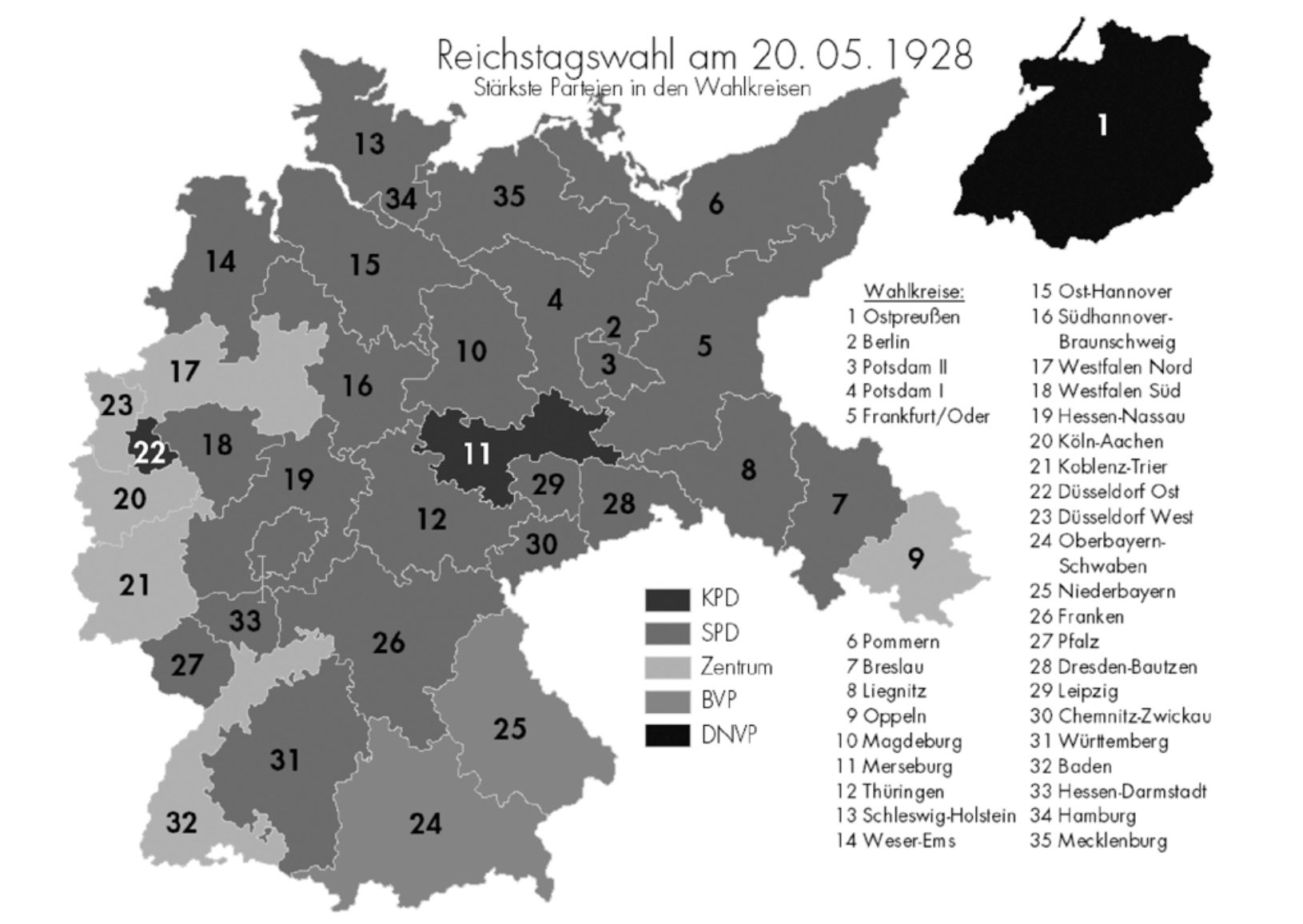
Figure 4: 1928 Election Results by District - Shaded according to the party with the largest share of the vote. The SPD's victory (red) is concentrated in urban areas, industrial regions, and Prussia, while conservative parties (blue/purple) dominate rural agricultural regions. Notice the NSDAP's near-total absence—they won only 12 seats nationally.
Voter turnout was 75.6 percent, providing the pro-Republic coalition led by the SPD with a solid mandate. Indeed, the only other party to gain significantly was the KPD. True, the two main Marxist parties may loathe each other, but their combined electoral victories (totaling 42 percent of Reichstag mandates) represent a significant turn away from the right-wing policies of the early 1920s. Radical right-wing parties have been marginalized; the NSDAP won only twelve seats, and the DNVP lost thirty seats. Prussia, by far the largest state in Germany, is an even stronger SPD stronghold ruled by an SPD-led coalition.
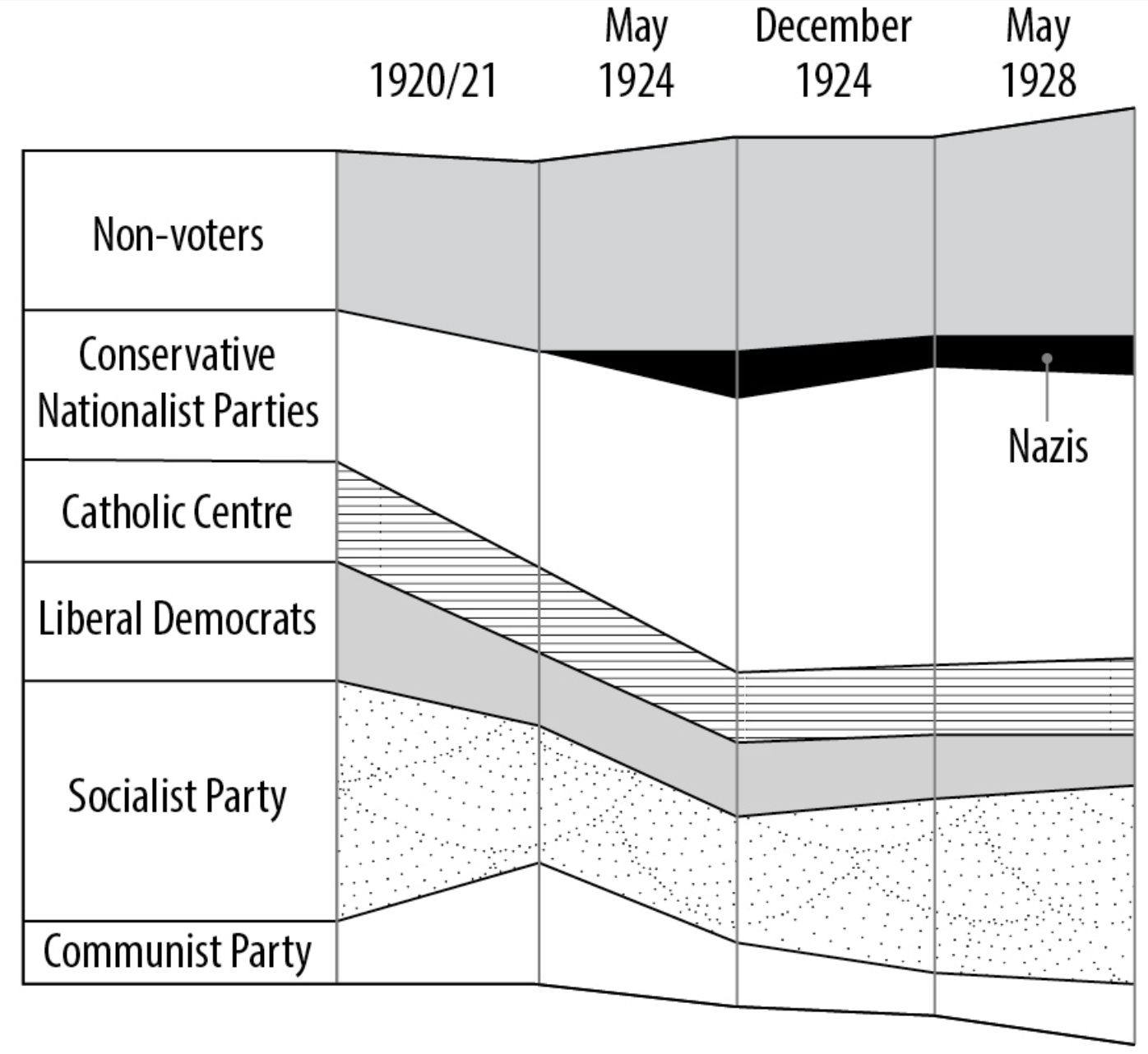
Figure 5: Composition of the Reichstag, 1920–1928 - The shifting balance of power across five elections. The SPD (red) reached its peak in 1928. The DNVP (dark blue) declined significantly from its 1924 high. The Centre Party (black) remained relatively stable. The NSDAP (bottom, barely visible) remains marginal with only 12 seats in 1928—seemingly a spent force.
The Fragile Coalition
The center-left victory is nonetheless tenuous. The conservative nationalist parties (DNVP, DVP, BVP, and other smaller right-wing parties) remain powerful. No majority center-right coalition is possible with just the conservative nationalist parties, but neither is a center-left without defections from the conservative nationalist block.
The ruling Grand Coalition in 1928 consequently includes both the DVP and the Centre Party's conservative Bavarian offshoot, the Bavarian People's Party (BVP). The coalition has suffered from internal divisions, but a general sense of compromise and confidence has pervaded under the firm but compromising hand of Stresemann. Most in the government hope his recent death will not mean the end of the coalition.
Continuity with the Kaiserreich
Despite the abdication of the kaiser, the November Revolution, and the creation of a new constitution, the Republic must also cope with a great number of continuities from the Kaiserreich.
- Neither the agrarian nor the industrial economy has undergone a deep restructuring, despite a series of reforms that supposedly protect workers and peasants
- The Reichstag largely continues the same parliamentary party alliances as before
- The position of the Reich president is consciously viewed as a substitute for the kaiser
- The old elite insist on the maintenance of their social and cultural distinctions
Further, all of the leading politicians grew up under and were shaped by the Kaiserreich and its aristocratic, authoritarian militarism. In the ten years since the collapse of the Kaiserreich, there has been surprisingly little change in personnel in any of the key institutions. The same people continue to dominate the schools and universities, the Reichswehr, and the judiciary. Almost all of the civil servants served in those institutions before the revolution.
Individuals who had been at the top of the socioeconomic ladder under the Kaiserreich remain ensconced and unwilling to share that status:
- Bourgeois employers persist in their implacable hostility to unions
- Aristocrats look down on the bourgeoisie
- Protestants doubt the loyalty of Catholics
- The military opposes any reform of its officer corps
- Antisemitism thrives in all but the Marxist and left-liberal parties
- Junkers demand and receive special preference for their estates, even as smaller farms struggle
In fact, much of one's attitudes toward the Republic depends on whether one was a winner or a loser in the Kaiserreich; the old elites resent the changes and express a corresponding hostility to the Republic. They look nostalgically to the past.
On the other hand, newly empowered groups—workers, women, Jews, socialists, bourgeoisie—place their hopes in the Republic. In short, the Republic is based as much on continuity with an authoritarian past as on hopes for a democratic future.
Late 1929: Dancing on a Volcano
And now we find ourselves in the autumn of 1929. President von Hindenburg began the year with the traditional New Year's message, a custom dating back to the kaiser. His tone expressed the sullen resentment of many, especially regarding the Treaty of Versailles:
The entire German people greets today the beginning of the new year with deep bitterness, because a great part of our land is denied the freedom to which we have just claim—just in God's eyes and in man's eyes. We have long hoped for its attainment. And we still want to hope, despite harsh disappointment, that in the new year the German people will be given back its full right of self-determination.
Since then, new crises have wracked the Republic:
- The stock market crash on Wall Street has produced a global shock wave
- Foreign creditors have begun withdrawing loans, threatening insolvency in German companies, national default on reparation payments, and soaring unemployment
- In late 1928, Stresemann warned, "The economic position is only flourishing on the surface. Germany is in fact dancing on a volcano. If the short-term credits are called in, a large section of our economy would collapse."
The Grand Coalition partners have been attempting to agree on the best way to deal with the growing economic crisis, which is exacerbating differences on matters from foreign policy to cultural policy. The anti-Republic parties of the Left and Right (the KPD, NSDAP, and the DNVP) seem to be gaining strength. Stresemann's death at this critical moment accentuates the sense of parliamentary crisis.
The Questions Before You
Are the Golden Twenties over? Will Germany return to the political chaos and economic insecurity of the early 1920s?
Does the NSDAP plan to seize power like the fascists did in Italy under Mussolini?
Is the KPD planning another communist revolution?
Will the Reichswehr continue to support the constitution?
Will France, Poland, or the Soviet Union take advantage of this deepening crisis?
Your Simulation Begins Here
It is late October 1929. You are a member of the Reichstag. The Grand Coalition is fracturing. The economy is collapsing. Extremists are gaining strength.
Will you save democracy—or watch it die?