Game Overview
The game unfolds across three years from late 1929 to the end of 1932; a game session is equivalent to roughly half a year.
Timeline
- Session 1: Late 1929 (October - December)
- Session 2: Early 1930 (January - June)
- Session 3: Late 1930 (July - December)
- Session 4: Early 1931 (January - June)
- Session 5: Late 1931 (July - December)
- Session 6: Early 1932 (January - June) - Presidential Election
- Session 7: Late 1932 (July - December) - Final Session
How to Prepare
- The "Historical Background" provides the broad context for the issues.
- The "Core Texts" introduce the main ideological frameworks.
- The "Supplemental Documents" provide specifics to each issue.
- Faction-specific readings (provided by the GM) give a party perspective on each issue.
- Your role sheet details your particular stance and goal.
- The role sheet and bibliography suggest extra readings to round out your views.
Major Items for Debate
The debates fall into several broad categories, each subordinated to a cabinet member's portfolio (see Table 2). All "mandatory items" must occur on the agenda at the start of the corresponding session and cannot be avoided. All "discretionary items" must be fought for to be placed on the agenda. Victory conditions are tied to the mandatory and discretionary items.
Table 2: Major Items for Debate
| Portfolio | Mandatory Items | Discretionary Items |
|---|---|---|
| Foreign Relations (Foreign Ministry) |
• Freedom Law • Young Plan • Liquidation Treaty with Poland |
(None listed as discretionary) |
| Military Affairs (Defense Ministry) |
• Naval Bill #1 | • Paramilitaries • Naval Bill #2 • Naval Bill #3 |
| Sexuality and Eugenics (Justice Ministry) |
• Mother's Day vs. International Women's Day | • Eugenics (Lex Zwickau) |
| Race and Culture (Interior Ministry) |
• Antisemitism and the "Jewish Question" | • Censorship and All Quiet on the Western Front |
| Industrial Relations (Economics Ministry) |
• Austerity | • Nationalization of the banks |
| Agricultural Affairs (Food Ministry) |
• Grain tariffs | • Small farmers' relief |
Foreign Relations (Foreign Ministry)
Foreign policy debates revolve around how Germany should relate to the Versailles system.
The Freedom Law
The Freedom Law would make any cooperation with Versailles a treasonable offense. Can Germany risk offending the world community in the name of German honor?
The Young Plan
The Young Plan would modify reparation payments and awaits Reichstag ratification. Would passing the Young Plan make reparations manageable or only kick the can down the road and simultaneously grant legitimacy to reparation payments?
The Liquidation Treaty with Poland
The treaty resolves trade issues and limits the transfer of German property in Poland to Poles. Is this simply validating the annexation of German territory?
Military Affairs (Defense Ministry)
Within the restrictions of Versailles, the Reichstag must grapple with the role of the largely autonomous Reichswehr, national security, and nongovernmental paramilitaries.
Naval Bill
The military demands full funding of three armored cruisers. Can an increased military budget be justified when social spending is being cut and would it risk the ire of the Allies?
Paramilitaries
Political street violence is escalating. Should the Reichstag or president ban paramilitaries? A permanent ban would be a constitutional change and require a two-thirds majority.
2nd and 3rd Naval Bills
Since the naval funding bill is an annual expenditure, it must come up in two later sessions as a discretionary item to continue funding; otherwise, funding stops.
Sexuality and Eugenics (Justice Ministry)
Modernization has challenged every notion of gender, sexual norms, reproduction, and national health, eliciting visceral responses.
Mother's Day versus International Women's Day
Competing visions of womanhood mean competing visions of a woman-centered national holiday. Can the Reichstag agree on what it means to be a German woman?
Eugenics
The proposed Lex Zwickau advocates sterilization for various categories of people deemed "unproductive." Is this a great advance for national health or a descent into immorality?
Race and Culture (Interior Ministry)
Germans disagree on who is rightfully German and thus entitled to citizenship with some proposing restrictions based on politics, religion, or even race. Others argue that the only way to unify Germany is to unify culture through censorship.
Antisemitism and the "Jewish Question"
No legislation restricting the rights of Jews has ever been proposed, but the strength of voelkisch nationalism makes it a constant national issue. Should the Reichstag take a clear stance?
Censorship and All Quiet on the Western Front
Everyone is talking about the book and movie. Should the Reichstag intervene to limit or possibly expand freedom of expression in this and future cases?
Industrial Relations (Economics Ministry)
In the growing economic crisis, scarce resources must be rationed against competing demands from the unemployed, agrarian constituents, big business, and the military.
Austerity
The budget is limited but unemployment is skyrocketing. Should unemployment insurance benefits to workers be cut to balance the looming deficit?
Nationalization of the Banks
Many blame international banks for the economic crisis. Should the state step in and nationalize private property in the national interest? Should this include Aryanization of the banks by removing Jews from ownership?
Agricultural Affairs (Food Ministry)
The agrarian crisis has fractured the countryside, and calls for state intervention mount as rural foreclosures lead to violence and the specter of urban hunger.
Grain Tariffs
The powerful Junker class insists upon high tariffs to protect their estates from international competition, even if this raises food costs, drains state coffers, and does nothing for small farmers. Should the state placate this important constituency at this high cost?
Small Farmers' Relief
Debt forgiveness or subsidized loans would protect small farmers from foreclosure, and land reform would confiscate and redistribute unproductive land. Would this only further distort the agrarian economy and violate property rights as a form of agro-Bolshevism?
Victory Objectives and Conditions
Your role sheet provides two sets of victory objectives (Factional—your party goals; and Personal—your individual goals). You should play to win the game in the same sense that politicians seek to get their agenda passed.
Achieving your victory objectives may seem impossible, but the game situation is highly fluid, even unstable. Anything is possible with:
- Alliances
- Negotiations
- Success at the polls
- Dogged determination
- Successful propaganda
- Changing circumstances
- Plain luck
Compromises are often necessary, but so is holding to principle. Sometimes simply staying in the game is a victory in itself.
Stability Index
The Stability Index abstractly represents the sense of crisis. The Index also reflects the degree to which forces that support the Republic versus those opposed are dominating events. Various events and actions cause the Index to rise or fall. The GM will provide regular updates.
Three Categories for the Index
| Category | Range | Meaning |
|---|---|---|
| HIGH | > 50 | Republic is stable; pro-democratic forces ascendant |
| NEUTRAL | −50 to +50 | Uncertain; fragile equilibrium |
| LOW | < −50 | Crisis deepening; anti-democratic forces ascendant |
The Index begins at +50, reflecting the successes of the Republic since 1924.
The Index Has Ramifications For:
- Reichstag elections (high favors pro-Republicans, low favors anti-Republicans)
- Presidential election (high favors pro-Republicans, low favors anti-Republicans)
- Chances for an insurrection's success
- Your character's victory conditions
Formal Structures of the Republic
The constitution states, "The German Commonwealth is a Republic. Political authority is derived from the People." However, the actual power hierarchy is a complicated semipresidential system in which power is divided between the president, cabinet, and Reichstag, as expressed in the flowchart of the Republic's basic power arrangement (Figure 6).
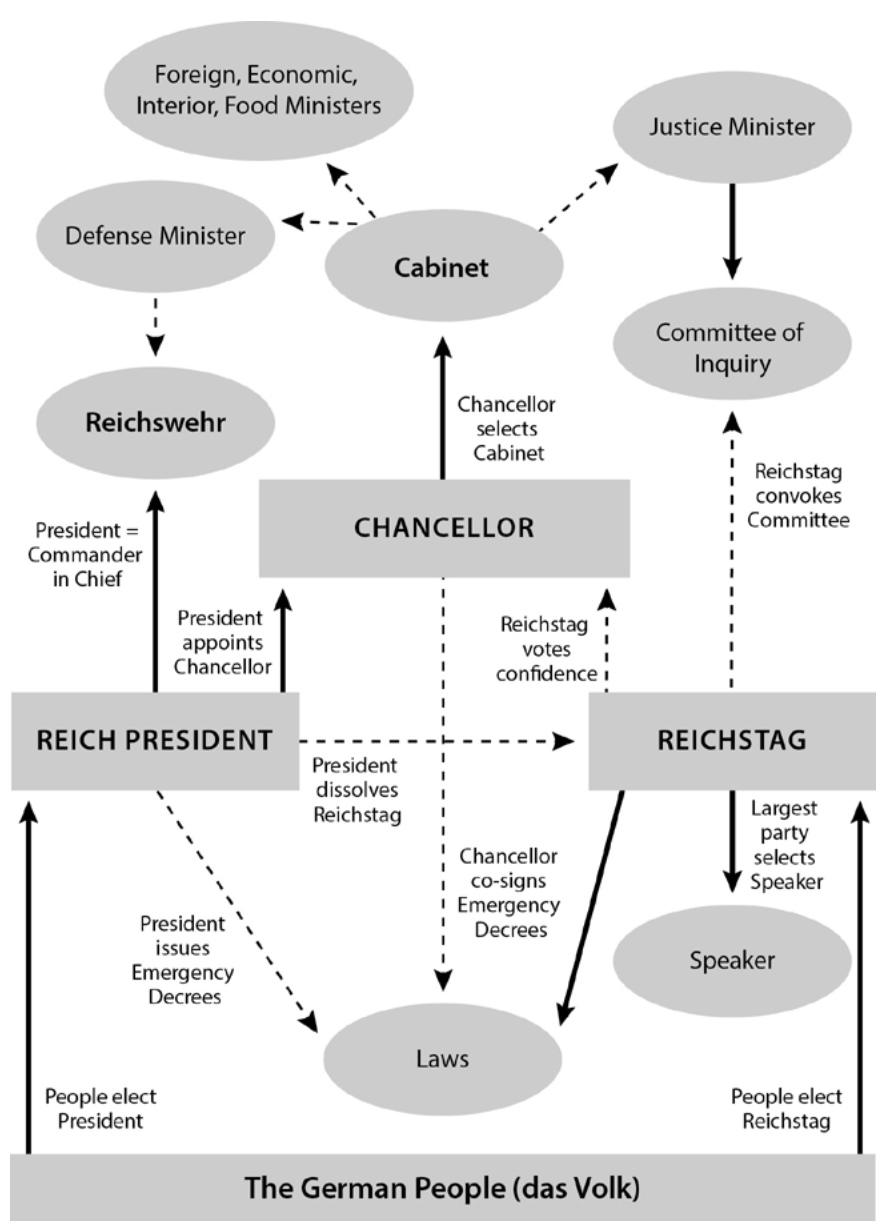
Figure 6: Flowchart of Republican Institutions - Solid arrows indicate direct authority, dashed lines indicate indirect influence. Notice how the President stands above both the Reichstag and the Cabinet, with the power to dissolve parliament and rule by emergency decree.
The German People (das Volk)
- Elect the president every seven years
- Elect the Reichstag at least every four years
The Reichstag
- Makes laws, grants amnesties, convenes inquiry committees
- Votes confidence in the chancellor, cabinet, individual ministers, or Speaker
- Selects the Speaker (chosen by the largest party)
The Speaker
- Controls debate and the agenda
The Reich President
- Issues emergency decrees
- Appoints the chancellor and approves the cabinet
- Dissolves the Reichstag and calls for elections
- Serves as commander in chief of the Reichswehr
The Chancellor
- Selects the cabinet
- Countersigns emergency decrees
The Cabinet (aka "the government")
- Deliberates on all matters and proposes legislation
- Ministers control portfolios and present relevant ministerial reports
- Defense minister communicates with the Reichswehr
- Justice minister oversees inquiry committees
The Reichswehr (the military)
- Answers to the president
- Acts autonomously from the Reichstag
- Coordinates with the Reichstag through the defense minister
The Supreme Court (embodied by the GM)
- Determines constitutionality of decisions and actions
Reich President (Head of State)
Paul von Hindenburg has been the Reich president since 1925. His popularity is immense, in part because of his reputation as the greatest German general of the war. Even many socialists and National Socialists find him appealing as a symbol of German pride.
The president does not directly shape legislation or exercise executive authority; these are left to the Reichstag and chancellor, respectively. However, the president does have a considerable amount of power, including:
Presidential Powers
Appointing the chancellor as head of government and approving the cabinet (Article 53).
Granting amnesty or pardon to anyone for any reason (Article 49).
Calling for new elections to the Reichstag at any time after the beginning of the second session (Article 25).
Issuing emergency decrees. These must be countersigned by the chancellor. The president may take emergency measures without the prior consent of the Reichstag. This power includes the promulgation of emergency decrees that amount to martial law and the temporary suspension of constitutional rights. The president, in cooperation with the chancellor, may, in effect, rule without the Reichstag, but the Reichstag may nullify emergency decrees (Articles 48 and 50).
Presidential Government—The 25/48/53 Formula
There is the constitutional possibility of a constitutional but antidemocratic "presidential government" based on the so-called 25/48/53 formula, which refers to the three articles of the constitution that could make a presidential government possible:
- Article 53 allows the Reich president to appoint the chancellor
- Article 48 allows the Reich president to sign into law emergency bills without the consent of the Reichstag; the chancellor must simply countersign them
- Article 25 allows the president to dissolve the Reichstag if it overturns an emergency decree
⚠️ The Death of Democracy
In effect, the president could appoint a chancellor regardless of whether or not they control a majority in the Reichstag, as a minority government, and rule through emergency decrees without the Reichstag (see Figure 7).
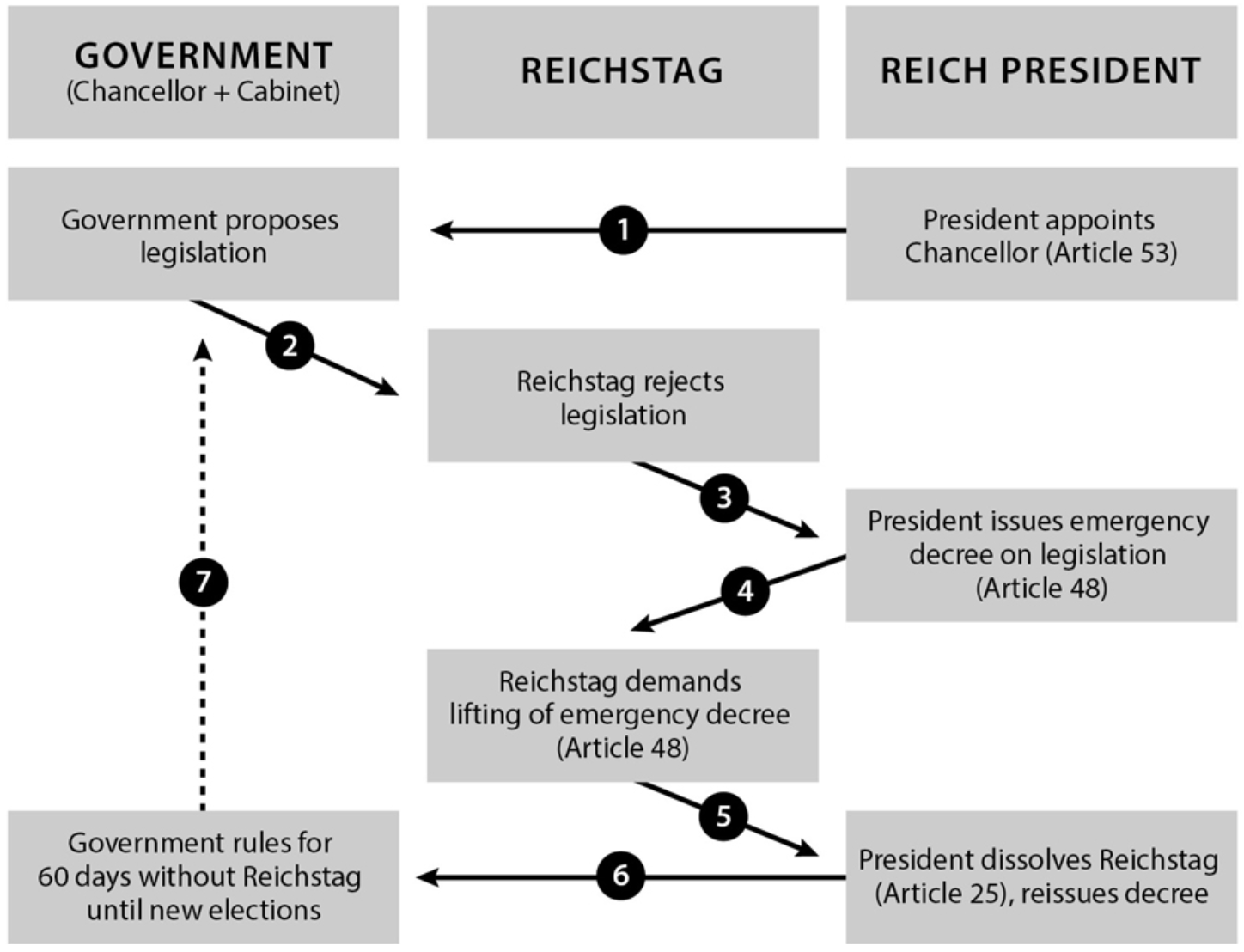
Figure 7: Flowchart of a Presidential Government - Under the 25/48/53 formula, the President can appoint a Chancellor without Reichstag support, rule by emergency decree (Article 48), and dissolve the Reichstag if it objects (Article 25). Democracy becomes a formality.
Presidential Election
The president is elected separately from the Reichstag and directly by all German citizens to a seven-year term. A regular presidential election must be held in April 1932 (the penultimate game session) unless a presidential recall has occurred.
A presidential candidate must be a German citizen and may not be a member of the Reichstag. If a member of the Reichstag is elected, that member must resign from the Reichstag, but their party does not lose any votes.
NB: There is no constitutional mechanism to delay the scheduled presidential election except for a recall (see "Presidential Recall").
Presidential Election Procedure
ROUND 1
Campaign Materials (Before Session 6):
- Every player develops an election poster for their ideal candidate (even if that candidate does not run)
- Campaign materials are produced PRIOR to the election (usually due in session 5 for elections in session 6)
- Posters may be hung in class or otherwise distributed
- The GM (or class, at GM's discretion) ranks the posters prior to the election
Voting:
- Candidates are announced and a secret vote is taken
- Players designate their current votes (splitting, abstaining, or all for one candidate). Since it is a secret ballot, there is no party discipline
- The GM makes adjustments based on ranking of posters and the Stability Index before announcing results
- The winner requires a simple majority of votes cast
- If no one wins an absolute majority, a second round is required
ROUND 2 (If Needed)
Any party with a candidate in the first round may choose to drop out or run a substitute candidate (but no new party or independent may put forward a candidate).
It is possible for a candidate to run as unaffiliated, with the consent of one of the parties that ran a candidate in the first round but now withdraws their candidate and gives permission for the new candidate to run in their stead, even without using the party's affiliation.
This second round occurs after a brief recess to allow caucusing, and it follows the same procedure as the first round.
- The winner does not require a majority but a plurality (highest number of votes)
- In the event of a tie, the presiding president will cast one vote
- The new president immediately takes office
Presidential Oath (Article 42)
Upon election, the president must make the following presidential oath in front of the Reichstag:
I swear to devote my energy to the welfare of the German people, to increase its prosperity, to prevent damage, to uphold the Reich constitution and its laws, to consciously honor my duties, and to exercise justice to every individual.
Presidential Recall
A presidential recall has three steps:
Step 1: Reichstag Vote
Two-thirds of the Reichstag must vote for a recall. If the vote is unsuccessful, nothing happens; the regular presidential election will occur as scheduled in the penultimate session. If successful, the president may not exercise their powers, which devolve onto the chancellor, until a referendum is resolved.
Step 2: Referendum
The GM supervises a referendum by secret ballot, following the rules for a presidential election but with only one round and a simple "yes" or "no" for the current president. The question reads: "Shall the current Reich president remain in office?" This referendum must pass by a simple majority.
If the referendum results in a majority "yes": The president is considered reelected for a new seven-year term; the regularly scheduled presidential elections do not occur. The Reichstag is automatically dissolved and a Reichstag election is held.
Step 3: Presidential Election (If Recall Succeeds)
If the referendum results in a majority "no," an immediate new presidential election must occur, following all rules for a regular presidential election. Referendum posters may be reused for the presidential election.
The Camarilla
The Camarilla are the unofficial advisers around the Reich president:
- Kurt von Schleicher runs the political wing of the Reichswehr and is currently the defense minister
- Otto Meissner is the state secretary to the Office of the Reich President, a career bureaucrat who served loyally under the former president, the socialist Friedrich Ebert
- There may be other members
Though they wield tremendous personal influence, they have no formal constitutional role in their capacity as members of the Camarilla. The Camarilla and president sit together, apart from the parties.
The Government (the Chancellor and the Cabinet)
The Chancellor
As the head of the government, the chancellor directs the work of the cabinet. Hermann Müller (SPD) is currently the chancellor of the Grand Coalition forged by Stresemann (DVP).
Although the chancellor is the head of the government, many powers of the office exist only in relationship to the president, and the Reichstag holds the chancellor accountable with its ability to motion no confidence. The chancellor does, however, have certain prerogatives, including:
- Selecting cabinet members
- Meeting with the president at any time
- Choosing to present the cabinet's position to the Reichstag on any matter
- Countersigning presidential decrees, thus exercising an effective veto power on such decrees (Articles 48 and 50)
- Fulfilling presidential functions should the president be unavailable (Article 51) or subject to a successful recall vote by the Reichstag (Article 43)
The Cabinet
The government includes the entire cabinet, comprised of the six ministry positions (portfolios) and the chancellor; there is no requirement that all of these positions be filled, and one person may fill multiple positions (see Table 3). The cabinet decides government policy by majority vote.
Table 3: Cabinet Members (Starting Composition)
| Position | Current Holder |
|---|---|
| Chancellor | Hermann Müller (SPD)* |
| Interior Minister | Carl Severing (SPD)* |
| Foreign Minister | Theodor Heuss (DDP) |
| Justice Minister | Heinrich Brüning (Centre) |
| Defense Minister | Kurt von Schleicher |
| Economic Minister | Eduard Dingeldey (DVP)** |
| Food Minister | Erich Emminger (BVP)** |
*If there are fewer than three SPD players, Müller serves as chancellor, interior minister, and Speaker.
**If Emminger is not in play, Dingeldey heads the food and economic portfolios.
Cabinet Responsibilities
The cabinet's primary role is to reach consensus and move legislation through the Reichstag by securing a majority in advance of any vote.
Protocol dictates that the minister with the relevant portfolio presents the government's position on any matter (unless the chancellor chooses to do so).
Members of the cabinet are expected to publicly support the cabinet's decisions, or at least refrain from public criticism—a position that may put them at odds with their party.
Ministerial Changes
A minister may resign at any time, or be voted out by a Reichstag vote of no confidence against the individual, or be kicked out by the chancellor. These will not necessarily bring down the government. The chancellor may replace the vacant seat as they please.
When the Government Collapses
The government collapses if one of the following happens:
- The ruling coalition loses a Reichstag majority for any reason: a party leaves the coalition; a party splits and reduces its numbers; an election changes the balance of power
- The chancellor or the full cabinet lose a vote of no confidence in the Reichstag
Forming a New Government
When the government collapses, the president may:
- Call on someone (including the current chancellor) to form a new government
- Call for new elections and afterward call for someone (including the current chancellor) to form a new government
- Do nothing and allow a minority government
When forming a new government, the Reichstag works on a European parliamentary model:
Majority Government
If a party has a majority (50 percent + 1 of votes in the Reichstag), the president usually but not necessarily calls on its leader to form a majority government.
Coalition Government
If there is no majority party, the president usually but not necessarily calls on the leader of the largest party to form a majority coalition government with other parties (the current coalition under Müller is such a government).
If that party leader is able to form a majority coalition, they create a new government with a division of cabinet positions as the coalition partners agree, usually with the leader of the largest party as chancellor.
There is no limit to how many parties can be involved in a coalition.
If the party leader chosen by the president to form a government cannot create a cabinet acceptable to the president, the president may ask another character to attempt to form a government.
Minority Government
The president may call on someone, including a person not in the Reichstag, to create a minority government. Lacking a majority, such a government has three legal options:
- A majority of the Reichstag may choose to "tolerate" the government (by abstaining, voting for its policies, and blocking any votes of no confidence), thus allowing the minority government to continue without necessitating a call for new elections.
- It can rule by presidential decree (see "Presidential Government—The 25/48/53 Formula").
- It can request that the president call for new elections.
Ministerial Reports and Questions for the Minister
Throughout the game, at the end of each session the GM will provide players with ministerial reports on important events requiring immediate action.
Procedure:
- The cabinet must develop an official government position before the next session
- At the beginning of the next session, the responsible minister (as indicated by the report) presents the government's position and proposals
- The presenting minister must remain at the podium after the report for "questions for the minister"
- During this time, the minister must answer all questions from the floor
- The questioners do not approach the podium but must stand at their places and be recognized by the Speaker before asking
- Questions must be in the form of a question (no speeches allowed—the Speaker will cut off any comments not in the form of a question and that person loses their right to raise a question)
- After all questions, the minister may return to their place and normal debate ensues
Failure to make a report affects the Stability Index.
The Reichstag
The Reichstag is the German legislature. It operates according to parliamentary principles that differ from those in the United States, so make sure that you understand them. Every player (except those in the Camarilla) is a member of the Reichstag and sits with their party.
Speaker of the Reichstag
The Speaker is the presiding officer of the Reichstag, currently Paul Löbe (SPD). The largest party in the Reichstag selects the Speaker immediately after every Reichstag election. Except in small games, the Speaker may not be in the cabinet.
Speaker's Powers
The Speaker controls the agenda and enforces the podium rule, which determines who can speak, in what order, and for how long. The Speaker:
- Calls sessions to order and announces the mandatory topic for discussion
- May take motions from the floor
- May recognize or ignore motions
- Adjusts the agenda
- Tables votes
- Otherwise exercises authority over the proceedings of the Reichstag
- May ignore requests to speak entirely, including from the chancellor or other members of the cabinet (but must always allow players to present on their topics)
- At the end of each session, selects the discretionary agenda topics
If the Reichstag becomes unruly, the Speaker may call on the president to use whatever means necessary to restore order as long as it does not violate the constitutional immunity of the members of the Reichstag. The Speaker may select a secretary to help keep order; this role may be filled by the GM.
Voting in the Reichstag: Mandates
Mandates (seats in the Reichstag, each with a vote) per party are based on the results of the 1928 Reichstag election. Each player controls an equal share of their party mandates (and thus votes). If there is a remainder after dividing equally, extra mandates go to the party leader (player #1).
The mandate distribution for Indeterminates depends on the number of Indeterminate players (the GM will provide these numbers—see Table 4).
Table 4: Reichstag Mandates (1928 Election Results)
| Party | Mandates | Percentage |
|---|---|---|
| SPD (Social Democrats) | 153 | 31.2% |
| DNVP (German Nationalists) | 76* | 15.5% |
| Centre (Catholic Centre Party) | 61 | 12.4% |
| KPD (Communists) | 54 | 11.0% |
| NSDAP (National Socialists) | 12 | 2.4% |
| Indeterminates (Various smaller parties) | 135* | 27.5% |
| TOTAL | 491 | 100% |
*If RLB (Agrarian League) is in play: DNVP = 73 mandates; Indeterminates = 138 mandates.
If new elections occur, the total number of mandates and their distribution may change. Historical outcomes, the Stability Index, and your party's propaganda success determine these numbers.
Decorum
There is no protocol for behavior in the Reichstag. Heckling, interjecting, and voicing loud support may occur. The Speaker attempts to maintain order through the vigorous ringing of a bell to call the house to order, but members often ignore the Speaker. Members can enter or leave the meeting as they desire. Mass walkouts may occur.
Players must verbally identify themselves by name, party affiliation, and ministry portfolio (if applicable) when speaking.
When a member of the cabinet addresses the Reichstag to present the government's views, members of the Reichstag have the right to ask questions (see "Ministerial Reports and Questions for the Minister").
Varieties of Legislation
The members of the cabinet handle the day-to-day operations of the government, but they must secure the approval of the Reichstag whenever they take dramatic action.
One-Fifth (20%) of the Reichstag Required To:
Convene an inquiry committee headed by the justice minister. A committee investigates any activity as directed—scandals and assassinations are good reasons. Before the start of the next session after a committee is convened, the justice minister informs the cabinet privately about the committee's findings. The cabinet then authorizes a report to the Reichstag, usually given by the justice minister (Article 34).
Simple Majority (50% + 1) Required To:
- Pass legislation, including the budget
- Ratify treaties or declare war
- Pardon criminals. The Reichstag regularly passes a Christmas amnesty paroling lesser political prisoners (Article 49)
- Revoke emergency decrees issued by the president (Article 48)
- Vote no confidence. A successful vote forces the resignation of the chancellor, a minister, entire cabinet, or the Speaker. If directed against the chancellor or the entire cabinet, the president may call a new election or ask someone else to be chancellor, probably with a new cabinet. In theory, the president could also reappoint the exact same chancellor and cabinet (Article 54)
Two-Thirds Majority (67%) Required To:
- Amend the constitution (Article 76)
- Pass Enabling Acts. Used frequently in the early days of the Republic, these grant the cabinet emergency powers, usually limited for a specific crisis
- Recall the president (see "Presidential Recall")
Motions of No Confidence
Motions of no confidence may come at any time (except during debate on a mandatory agenda item) for any reason from any Reichstag member. Indeed, if the government has just lost a vote, the logical step for the opposition parties is to make an immediate motion of no confidence.
They must be voted on immediately and cannot be blocked for any reason. Any number of motions of no confidence may be made per session, but only if made against different persons.
Voting Procedures in the Reichstag
Quorum
No quorum is required unless the Reichstag is amending the constitution, which requires two-thirds of members to be present (Article 76).
Debate
Once the Speaker has opened a topic for debate, that debate cannot be interrupted until all required speeches are given. After the speeches, the Speaker may call for a vote.
Calling for a Vote
Any Reichstag member may call for a vote. However, only the Speaker may place a vote on the agenda. If the Speaker refuses (see "Tabling"), the Reichstag may force a vote on an item by overriding the Speaker with a simple majority.
Voting
Once a vote begins, it must be taken immediately—no further debate is allowed, and it may not be interrupted or stopped for any reason.
Tabling
The Speaker may table a vote after all debate and not allow the motion to be voted on. The Reichstag may override the decision to table by majority vote and then move to an immediate vote on the previously tabled issue.
Exception: The Speaker may not table a motion of no confidence.
Order of Voting
The sponsoring party votes first; the Speaker then calls on parties to vote in any order.
Block Voting
Parties usually vote by block (the party leader announces all party votes at once). However, party members may break with party discipline and refuse to allow block voting for their party.
Voting Options
The party or individual may vote, abstain, or pass.
- If passing, the Speaker must call on every other party/individual before calling on the passing party/individual again
- A party/individual may only pass once
- If the party/individual abstains, the Speaker has the right to demand the reasons for the abstention
Proxy Voting
If absent, players are assumed to vote by proxy. In parties with more than one player, the leader of the party automatically controls those votes unless proxy instructions have been given to the GM.
The instructions may be broad ("I authorize X to cast my votes on all matters as X sees fit") or narrow ("I authorize X to vote yes/no on this particular matter only").
Tallying
The GM or appointed secretary keeps a tally and announces results.
Ties
In the event of a tie, the president may cast a deciding vote; otherwise, a tie is a defeat.
The Agenda
Mandatory Agenda Items
Every session except the last has at least one mandatory agenda item. Mandatory items cannot be altered for any reason (except by the GM). They must be resolved as the first agenda items of the session, in the order given, before any other action may be taken. Resolution requires full discussion though not necessarily a vote.
Mandatory Agenda Items by Session
| Session | Mandatory Items |
|---|---|
| Session 1 ✓ | 1. Freedom Law 2. Naval Bill #1 |
| Session 2 ✓ | 1. Young Plan 2. Austerity |
| Session 3 (not played) | 1. Grain Tariffs |
| Session 4 (not played) | 1. Antisemitism (if not used, then Eugenic Sterilization) |
| Session 5 (not played) | 1. Mother's Day |
| Session 6 (not played) | 1. Presidential Election |
| Session 7 (not played) | (No mandatory items) |
Discretionary Agenda Items
In the last five minutes of a session, the Speaker must determine two discretionary agenda items (A and B) for the next session. If time allows, these items will be debated in the next session in the order set by the Speaker after the mandatory items have been resolved.
Setting Discretionary Items
To select the discretionary items, the Speaker should:
- Meet with the cabinet
- Solicit input from Reichstag members
Although the Speaker sets the discretionary agenda, the Reichstag may overrule by majority vote and set alternate discretionary agenda items.
In either event, once the discretionary items have been approved, they may not be altered in the next session. However, after resolution of all approved agenda items for a session, new items may be added by the Speaker.
Rolling Over Items
If a discretionary item is not resolved, it does not automatically roll over to the next session. It must again be approved for an additional session or it is dropped from the agenda.
Political Parties
Party Discipline
All parties operate with party discipline. If a party calls for party discipline (determined by majority vote of party members), all members must vote as a block, with the party leader casting the vote. Failure to abide by party discipline can lead to disciplinary action by the party. If party discipline is not invoked, members may vote as they see fit.
What Members May Do
Members may always criticize their party privately, secretly, anonymously, and within party meetings.
What Parties Forbid
Parties forbid public criticism such as:
- Circulating critical articles
- Voting against the decision after party discipline has been invoked
- Conducting negotiations without the authorization of the party
- Speaking in the Reichstag against their party or fellow members
Disciplinary Actions
The game does not forbid public criticism. However, there should be consequences. It is up to the party to determine how to discipline members. The options may include:
- Expulsion from the party
- Removal from party posts
- A reprimand
- Reduction in party rank
A majority vote of all party members is required to discipline a member.
Only the GM may remove a member of the Reichstag from the legislature altogether.
In the event of a tie in an internal party vote, the party leader decides.
Coalitions, Alliances, Mergers, New Formations, and Bans
Coalitions
Coalitions are agreements between parties to form a government together. No single party has ever had an absolute majority of the Reichstag, so coalitions are the norm to achieve a working majority.
Potential Coalitions
| Coalition Name | Parties | Orientation |
|---|---|---|
| Weimar Coalition (Volksblock) | SPD, DDP, Centre | Left-center, pro-Republic coalition that formed at the start of the Republic; under various chancellors, 1919 to 1922 |
| Hindenburg Front (Reichsblock) | Centre, BVP, DVP, DNVP | Right-center, national-conservative block excluding Marxists and the NSDAP; elected von Hindenburg in 1925 |
| Bourgeois Block (Bürgerblock) | DDP, Centre, BVP, DVP | Nationalist-liberal moderate coalition excluding Marxists and völkisch parties; in power 1925 to 1928 |
| Grand Coalition (CURRENT) | SPD, DDP, Centre, BVP, DVP | Moderate pro-Republic coalition currently in power since 1928 |
| Populist Front (Völkische Front) | NSDAP, DNVP, DVP | Proposed far-right block that excludes moderates and Marxists |
Alliances
- United Front (KPD, SPD): A Marxist front to fight the extreme Right
- National Block (DNVP, DVP, and other right-of-center parties): A conservative front to fight both the Marxists and the NSDAP
Mergers
Mergers occur when two or more parties agree to dissolve their parties and create a new united party. Such a merger means that future elections occur under the name of the new party. There is no guarantee that all mandates of the merging parties will go along, however. The GM will determine how successful the merger was.
If the merger ceases to be useful, players can unmerge. Again, the GM will determine how successful the de-merger was.
Party Dissolution
- Voluntarily dissolving themselves
- Merging
- Being banned
- Not receiving any mandates in a Reichstag election
Banning a Party
Banning a party is an extraordinary step. It requires a two-thirds vote since it alters the constitutional right to association (Article 124). If banned, a party may reform under another name.
Reichstag Elections
Scheduled Elections
If no Reichstag election is called prior to the penultimate game session, one must occur in that session (the four-year term would end in early 1932).
If the regularly scheduled presidential election also occurs in that session (i.e., it has not been preempted by a successful recall referendum), the Reichstag elections would occur after the GM announces the new president.
Calling Elections
The president may call for early Reichstag elections at any time and for any reason after the start of the second session (Article 25). No more than one election may occur per session.
Influencing Elections
- Campaigning successfully; as assessed in the quality of writing and speaking, the GM may adjust results
- Moving the Stability Index: the GM may adjust results so that a higher Index favors pro-Republican parties, and a lower Index favors anti-Republican parties
Election Results
- The largest party selects the Speaker
- The president calls on someone (usually but not necessarily the leader of largest party) to form a new government as the new chancellor; that person need not be a member of the Reichstag
- The proposed chancellor consults with other parties, assembles a coalition, and proposes a cabinet to the president. If the president disapproves, they may ask for the same proposed chancellor to create a government more to their liking, or ask someone else to form a government to their liking
- If the president approves the government, the new chancellor presents the members of the cabinet and the goals of the new government to the Reichstag
- The new Speaker announces the agenda
- The eldest Reichstag member (Zetkin, KPD) addresses the Reichstag as the first agenda item (if Zetkin is not in play, this step is ignored)
Extraparliamentary Forces
Assassination
Assassination by right-wing death squads was common in the early 1920s. But since 1924, assassination of leading politicians has all but ceased. Nonetheless, the threat still exists, and threats, often delivered in not-so-veiled homilies in the Reichstag, right-wing broadsheets, or in anonymous letters, should be taken seriously.
Foreign Intervention
Foreign powers may choose to intervene. The French intervened in the early 1920s and still occupy the Rhineland. The Comintern (the Moscow agency that coordinates international communism) has supported a variety of communist revolutions around the world. The Vatican regularly issues proclamations in support of Catholics. The United Kingdom has no desire to see the Versailles system unravel. Italy seeks to extend its influence into Austria and the Balkans. Poland and Czechoslovakia have significant tensions on their new borders with Germany.
Anyone may appeal to any foreign power for assistance (military, diplomatic, financial, or otherwise) by writing to the GM in their role as the relevant foreign counterpart. You will need to research who this counterpart might be.
Green Front
The Green Front is a nonparty block of often competing agrarian interests that was formed in 1929 with the hope of creating a single united organization that will ideally grow into a unified national agrarian party to strengthen farmers' voices. Its members include the CNBP, RLB, DBP, Centre, and NSDAP.
Paramilitaries
Several parties have affiliated but autonomous paramilitaries with military-like training. These are (usually) legal and often intervene directly in political affairs. They may engage in street fighting and insurrections, and include:
Major Paramilitaries
| Party | Paramilitary | Character |
|---|---|---|
| BVP | Homeland Defense (Heimatschutz) | Only in Bavaria |
| CNBP | Rural People's Movement (Landvolkewegung) | A terrorist protest movement |
| DNVP | Steel Helmet (Stahlhelm) | The largest paramilitary by far, but respectable |
| KPD | Red Front (Rotfrontkämpferbund) | CURRENTLY BANNED (May 1929) |
| NSDAP | Storm Troopers / Brownshirts (Sturmabteilung, SA) | Openly militant, thuggish |
| SPD/Centre/DDP | Banner of the Realm (Reichsbanner) | A joint paramilitary, respectable |
Reichswehr
Since Versailles restricts the Reichswehr to one hundred thousand men, it has limited combat abilities. However, it is a handpicked elite led by conservative officers with monarchist loyalties who defend its autonomy from Reichstag control.
It appears to be utterly devoted to von Hindenburg, but von Schleicher makes day-to-day decisions.
Character Death and Respawning
German politicians sometimes were assassinated, died unexpectedly, or lost all relevance. What happens if your character dies or your party is eliminated? Do you automatically lose?
Not to worry! You simply respawn, but as another character. The GM will inform you of your new character. Your victory objectives become those of your new character.
Basic Outline of the Game
Our game begins in late 1929, just after the U.S. stock market crash and as the German Reichstag begins deliberation on the Freedom Law and Naval Bill. You are part of the Reichstag, belonging to one of the various political parties. Beginning with the Young Plan, you must debate a variety of matters ranging from foreign affairs to cultural matters, all informed by primary sources.
Each session covers roughly six months of historical time, and you will have to confront unfolding events that directly impact Germany while also dealing with domestic elections and unrest. You face a series of events where you, not the dead hand of history, decide what will happen. Thus, within the parameters of the historical reality of the Republic, you must consider all of the options actually available and confront the consequences of your choices.
Importantly, every decision made by you has an impact on the Stability Index, a measure of how volatile the German electorate has become: the greater the instability, the greater the radicalization of the German electorate. Thus you must decide how best to maneuver politically in the Reichstag, all the while considering the impact on the next election.
⚠️ When Parliamentary Democracy Fails
If the Reichstag cannot resolve its internal disputes based on majority rule, the game allows for a variety of tactics:
- Dissolution of the Reichstag
- Emergency decrees
- Street violence
- Martial law
- Assassination
- Mass insurrections
Typical Game Session Cycle
1. Start of Class
a. GM announces/posts updates
- i. Stability Index
- ii. Party mandates
- iii. Speaker and cabinet
b. Speaker announces/posts agenda
2. Reichstag Actions
a. Agenda items
i. Discussion of mandatory agenda items
- 1. Cabinet presents its stance
- a. Questions for the minister
- 2. Speeches and debate
- 3. Caucus, vote, or table
ii. Discussion of discretionary items
b. Interruptions
- i. Only after full debate of agenda item being discussed
- ii. Votes of no confidence, street violence, emergency decrees, dissolution of parliament, caucuses, etc.
3. End of Class
a. Speaker sets new discretionary items
4. After Class
a. GM provides ministerial reports and updates
b. Cabinet meets outside of class to determine stance on ministerial reports
c. Players meet outside of class to plot strategy
Initial Reichstag Agenda
Session 1
- Freedom Law by Hugenberg (DNVP); rebuttal by interior minister
- Naval Bill #1 by Defense Minister von Schleicher
- If time permits, proceed with items from Session 2
Session 2
- Young Plan by Chancellor Müller (SPD)
- Austerity by Economic Minister Dingeldey (DVP)
- Discretionary Item A as determined by Speaker at end of Session 1
- Discretionary Item B as determined by Speaker at end of Session 1
Debriefing
After the game, the GM debriefs players, providing historical closure to determine the fate of German democracy and individual players. The debriefing also helps players to exit from the game, provides an opportunity for reflection, and gives the GM a chance to set the record straight by telling the players what really happened.
Assignments
Every player should engage the class through oral participation (speaking in the Reichstag sessions and caucusing), writing (your papers), and visual creativity (the campaign poster).
Quick Overview
Oral Participation
Depending on class size, the GM will inform you how often and at what length you must speak before the Reichstag to receive full credit. In smaller classes, you should expect to speak on a daily basis; in larger classes perhaps only once per week.
Some characters are required to speak on set matters. Hugenberg (DNVP) speaks on the Freedom Law. Clara Zetkin delivers the "First Address" after any Reichstag election. Cabinet members present the government's views, often triggered by GM updates.
Papers
Depending on the GM's need, you will write two papers (3–5 pages) or three papers (2–4 pages). Your role sheet defines your topics. The GM will provide length and citation expectations. In general, though, you must draw on the "Core Texts" and factional readings.
Visual Creativity (Election Poster)
You must produce an election poster for the presidential election for your preferred candidate (listed in your role sheet) prior to the start of the election (usually the penultimate session, unless preempted by a successful presidential recall referendum). You are not obligated to vote for this candidate.
The poster should be on a half poster board (14″ × 22″) unless otherwise specified by the GM. It may be designed in any style related to the aesthetics of the era; you may imitate models or be more creative.