Welcome to the Reichstag
It is October 1929. You are a member of the German Reichstag during one of history's most critical moments. The "Golden Twenties" are ending. The American stock market has just crashed. Unemployment is rising. Political extremists on both the left and right are gaining strength.
Germany's young democracy—only ten years old—faces its greatest test. The moderate parties that have governed since 1919 are fracturing. Communists demand revolution. Nazis promise a "new Germany" based on racial purity and authoritarian rule. Street violence is escalating. The economy is collapsing.
Will you preserve democracy? Will you compromise your principles for stability? Will you risk everything for your ideals?
The Stakes
- You represent one of 12 political parties in the Reichstag, each with different visions for Germany's future
- No party has a majority—coalition-building is essential, but your parties fundamentally disagree
- Every decision affects the Stability Index—push it too low and democracy collapses
- History is not predetermined—your choices will determine whether Germany remains democratic or falls into dictatorship
- You will face impossible dilemmas—between your principles and political survival, between democracy and order, between compromise and conviction
The Challenges Facing Germany
💰 Economic Crisis
The Treaty of Versailles demands impossible reparations payments. American loans that sustained the recovery are being recalled. Unemployment is soaring past 3 million. Farmers face bankruptcy.
The question: Do you impose austerity and cut unemployment benefits to balance the budget? Or do you maintain social spending and risk economic collapse?
⚔️ Political Extremism
Communists (KPD) want Soviet-style revolution. National Socialists (NSDAP) demand an authoritarian racial state. Nationalists (DNVP) want to restore the monarchy. Each rejects parliamentary democracy.
The question: Can moderate parties (SPD, Centre, Liberals) hold the center? Or will Germans turn to extremism in desperation?
🔥 Street Violence
Paramilitary groups clash in German streets: the Nazi SA (Storm Troopers), the Communist Red Front, the Social Democratic Reichsbanner. Each numbers in the hundreds of thousands. The police are overwhelmed.
The question: Do you ban the paramilitaries and risk civil war? Or tolerate political violence and watch democracy erode?
📜 Constitutional Crisis
President Hindenburg—a monarchist who despises democracy—can rule by emergency decree (Article 48). He can dissolve the Reichstag and call new elections. The military (Reichswehr) operates beyond democratic control.
The question: Will you use authoritarian tools to "save" democracy? Or watch as anti-democratic forces use those same tools to destroy it?
🌍 Foreign Relations
All Germans hate the Treaty of Versailles. But challenging it risks French invasion, international isolation, and economic catastrophe. The Young Plan offers relief—but requires accepting the "war guilt lie."
The question: Do you accept humiliation for stability? Or risk everything to restore German honor?
🗳️ Democratic Fragility
Proportional representation means 12+ parties in the Reichstag. No stable majority is possible. Coalition governments collapse constantly. Voters are losing faith in democracy.
The question: Can you make democracy work? Or will gridlock and chaos prove that Germany needs a "strong hand"?
Understanding Weimar Germany
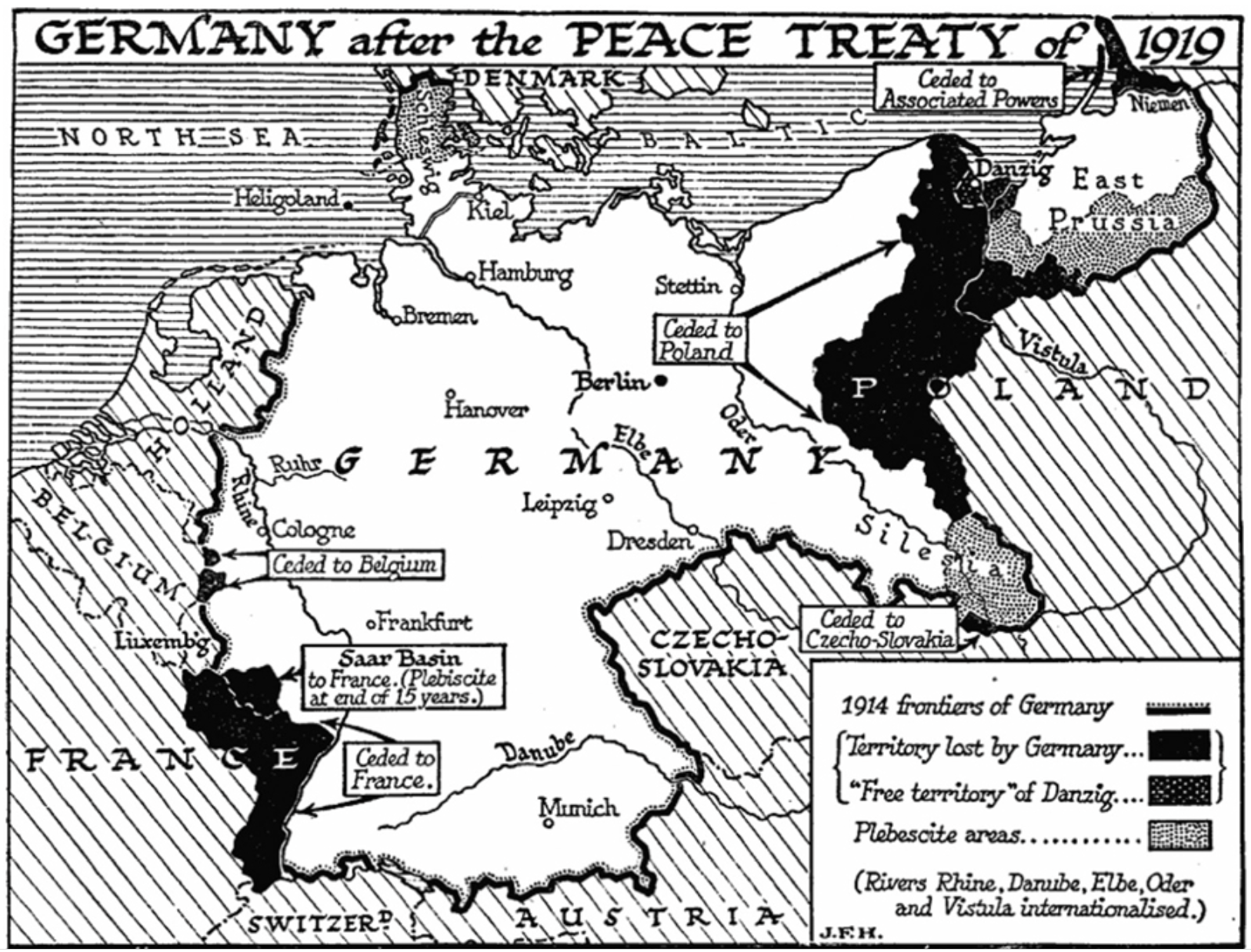
Treaty of Versailles Territorial Revisions (1919): Germany lost 13% of its territory and 10% of its population. Alsace-Lorraine returned to France (west). The "Polish Corridor" (West Prussia, Posen, and Danzig) was ceded to Poland, cutting off East Prussia from the rest of Germany. Northern Schleswig went to Denmark. Eupen-Malmedy to Belgium. Upper Silesia to Poland and Czechoslovakia. The Rhineland and Saarland were occupied by French troops. No German political party accepted these borders as legitimate.
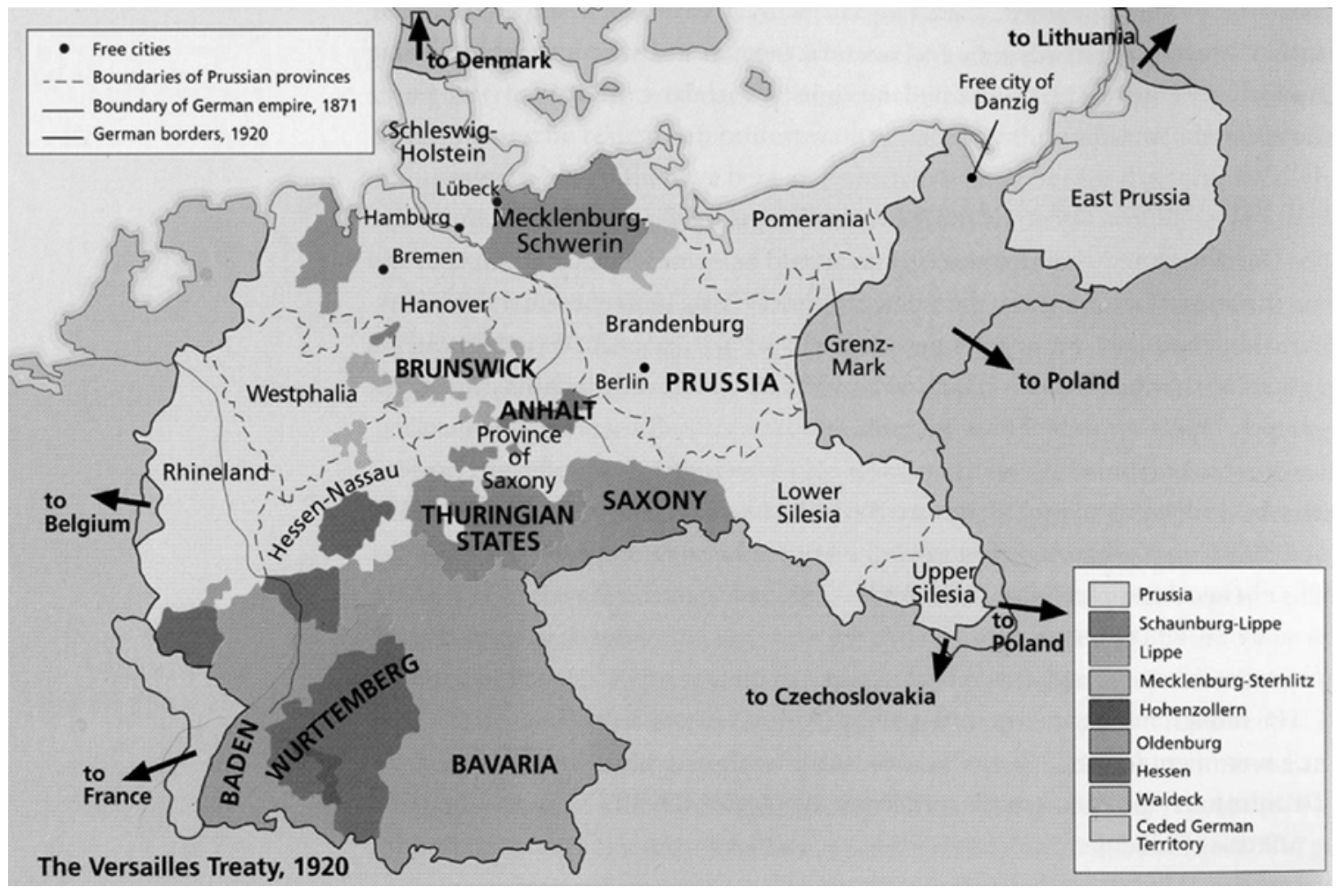
German Racial and Cultural Territory (1925) - Albrecht Penck's Lebensraum Map: This influential map shaped German nationalist thinking. Dark areas (Volksboden) show where Germans were the primary speakers—these areas "should" be part of Germany. Gray areas (Kulturboden) show German cultural influence—these areas were "appropriate for colonization and Germanization." Notice the "German islands" in Eastern Europe—isolated pockets that nationalists saw as bastions for future expansion toward Russia and the Balkans. Pan-Germanists demanded a "Greater Germany" including Austria and the Sudetenland.
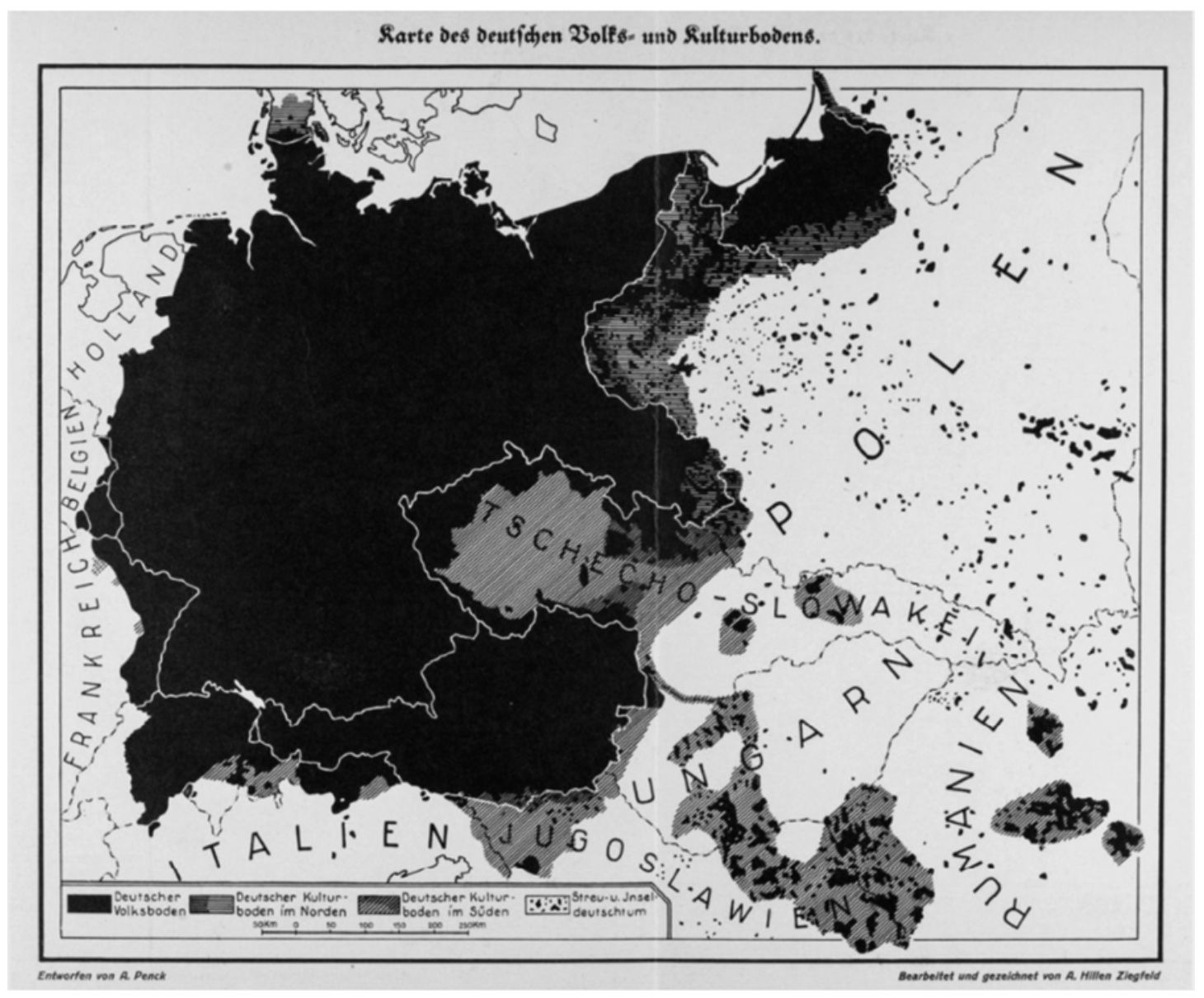
German States and Prussian Provinces (1929): Prussia dominated— occupying almost two-thirds of Germany. East Prussia (exclave, cut off by the Polish Corridor) was the homeland of the Junkers—the Protestant landowning aristocracy who dominated the military and hated democracy. Yet "Red" Berlin, Hamburg, and the Ruhr were bastions of Social Democracy. Bavaria (Free State)—conservative, Catholic, monarchist, separatist—was home to both the Centre Party and the NSDAP (headquartered in Munich). Hanover— a former kingdom annexed by Prussia in 1866—where many demanded restoration as a separate state. Germany was deeply divided regionally, religiously, and politically.
Why These Maps Matter for the Simulation
- The Polish Corridor is THE most explosive issue in German politics. Every party—from Communists to Nazis—rejects it. Debates over foreign policy will center on whether to challenge Versailles.
- Lebensraum ideology (Penck's map) shows how nationalists thought. The NSDAP and DNVP don't just want 1914 borders back—they want a racial empire stretching into Eastern Europe.
- Regional divisions matter. Prussian Junkers (East Prussia) vs. Bavarian Catholics (BVP) vs. "Red" Berlin (SPD) create deep cultural and political fractures. You'll see this in coalition-building.
- The stakes: Every debate about foreign policy, military affairs, or the Young Plan connects to these maps. Accepting Versailles means accepting "national humiliation." Rejecting it risks French invasion and economic catastrophe.
Prologue: October 1929
October 3, 1929: Gustav Stresemann, Germany's Foreign Minister and architect of international rehabilitation, dies suddenly at age 51. His death removes a crucial stabilizing figure from German politics.
October 24, 1929: "Black Thursday." The New York Stock Exchange crashes. Within days, American banks begin calling in loans to Germany. The fragile economic recovery—built entirely on American credit—is ending.
Late October 1929: The "Grand Coalition" government debates the Young Plan (reducing reparations) and unemployment insurance. Chancellor Hermann Müller (SPD) struggles to hold his coalition together.
In the Reichstag, tensions simmer:
- The Social Democrats (SPD) defend workers' unemployment benefits. "We will not betray the working class!"
- The Liberal parties (DDP, DVP) demand fiscal austerity. "We cannot spend money we don't have!"
- The Centre Party tries to mediate. "We must find common ground."
- The Communists (KPD) denounce the SPD as "social fascists" and call for revolution. "The Republic is capitalist tyranny!"
- The Nazis (NSDAP) and Nationalists (DNVP) attack the "Versailles system" and call for dictatorship. "Democracy has failed Germany!"
- Behind the scenes, President Hindenburg and Defense Minister von Schleicher plot to exclude the SPD from power.
You are about to enter the Reichstag. The choices you make in the coming sessions will determine whether German democracy survives—or whether it gives way to dictatorship.
We know how this story ended in 1933. But in 1929, nothing was inevitable. Different choices could have produced different outcomes.
What will YOU choose?
Connection to Your Research Paper
This simulation directly addresses your research paper's central question:
"How and why do democratic or revolutionary governments fail, and under what historical conditions do authoritarian systems emerge in their place?"
You Will Experience:
- Democratic institution erosion through emergency decrees and parliamentary gridlock
- Economic crisis driving political radicalization
- Coalition fragility when parties prioritize ideology over governance
- Political violence and its normalizing effect
- The attraction of authoritarianism when democracy seems "weak"
- How "good people" make democracy-destroying choices
Perfect Case Study Pairing:
Democratic Government (1750-1920): Weimar Republic (1919-1933)
Authoritarian Government (1920-present): Nazi Germany (1933-1945)
You'll experience the transition from one to the other—and understand how and why it happened.
⚠️ Important Notes
Prohibited Content
This simulation strictly prohibits:
- Nazi symbols (swastikas, Hitler salutes, Nazi uniforms)
- Racial slurs or dehumanizing language
- Any glorification of violence or extremism
Why? These symbols cause harm and prevent learning. You will engage with Nazi ideas through primary sources—but you will not perform hate symbolism.
Challenging Content
This simulation addresses difficult topics:
- Antisemitism and racial ideology
- Political violence and assassination
- Economic suffering and social crisis
- The failure of democratic institutions
Remember: You are playing a role, not expressing your own beliefs. Attack arguments, not people. Stay in character, but stay human.
Learning Objectives
This is not a game about Nazis or the Holocaust—it's about how democracies die:
- Understanding democratic fragility and institutional erosion
- Experiencing the dilemmas of coalition politics
- Recognizing how economic crisis drives extremism
- Seeing how "normal people" make catastrophic choices
- Learning from history to protect democracy today
Historical Deep Dives
Explore specific aspects of Weimar Germany that will shape your debates:
Quick Reference
📅 Timeline
- Week 1: Setup & Background
- Week 2: Coalition Politics
- Week 3: Democratic Crisis
- Week 4: Collapse & Analysis
📝 Assignments
- 3 Position Papers
- 1 Election Poster
- Reichstag Speeches
- Participation/Voting
🎯 Key Concepts
- Proportional Representation
- Article 48 (Emergency Decrees)
- Stability Index
- Coalition Building