The Political Spectrum
No single model captures the political spectrum of the Republic, especially because it shifted over time. However, the diagram below uses a traditional "left-right" political spectrum and places the political parties, paramilitaries, and special interest groups in their approximate relationship to each other.
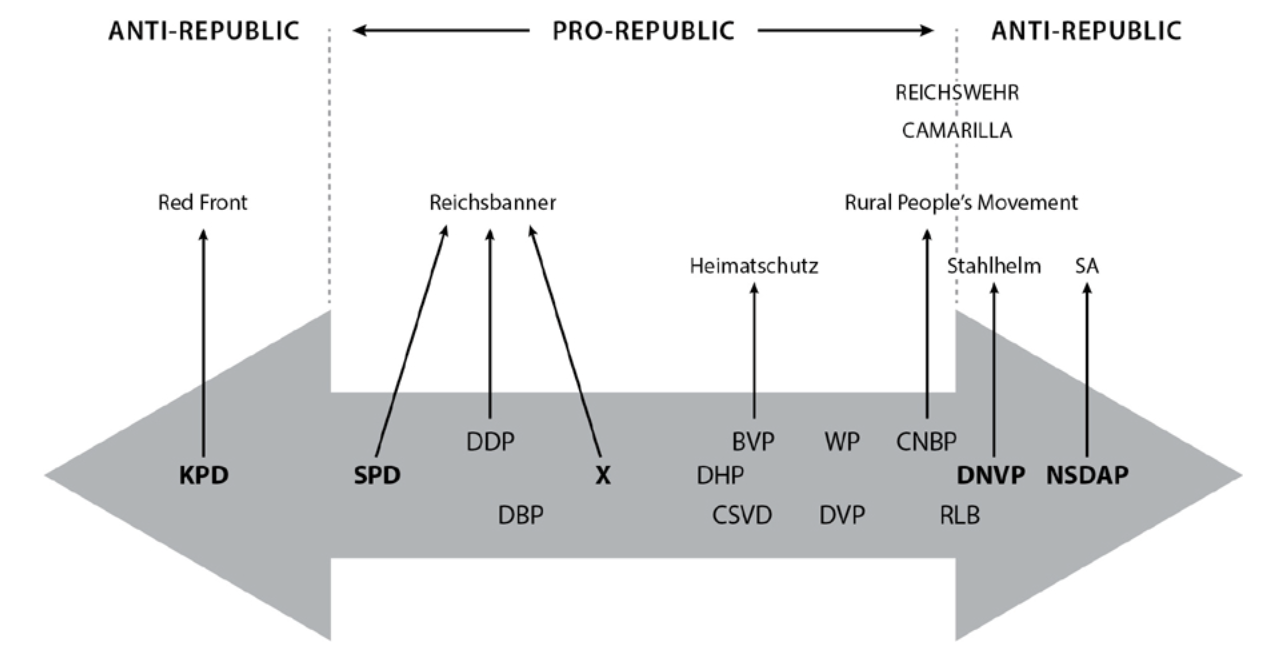
Figure 8: Political Parties, Paramilitaries, and Special Interest Groups - Since both extremes (KPD and NSDAP) were anti-Republic, a horseshoe effect brought them closer together, making tactical alliances possible. On the far right, many groups straddled the pro- and anti-Republic line. Every party consisted of a spectrum, with left and right wings and a moderate middle trying to hold them together.
Understanding the Spectrum
Key points:
- The extremes meet: KPD (far left) and NSDAP (far right) both oppose the Republic
- Paramilitaries: Shown above parties with arrows indicating affiliation
- Special interest groups: Labeled in ALL CAPS (e.g., GREEN FRONT)
- Pro-Republic parties: SPD, DDP, Centre (the "Weimar Coalition")
- Anti-Republic parties: KPD, NSDAP, DNVP (though DNVP wavers)
- Internal divisions: Every party has left, right, and center wings
The Main Parties
Five major parties dominate the Reichstag, plus one powerful non-party faction (the Camarilla). Click on any party to learn more about its ideology, leaders, and goals.
The Camarilla
Authoritarian / Monarchist / Militarist / Reactionary
The circle of men around President von Hindenburg. Highly influential. Promote military autonomy. Unrepentant monarchists. Secret workings may subvert the Republic.
Reichstag Seats: None (not a party)
SPD
Social Democratic Party of Germany
Social Democratic / Socialist / Democratic Socialist / Marxist
The largest party. Supports the Republic. Marxist roots but democratic methods. Champion of workers, welfare state, and social justice. Currently leads the Grand Coalition.
Reichstag Seats: 153 / 491 (31.2%)
KPD
Communist Party of Germany
Communist / Bolshevik / Marxist
Largest communist party outside USSR. Committed to revolution. Loyal to Stalin and Comintern. Denounces SPD as "social fascists." Implacably anti-Republic.
Reichstag Seats: 54 / 491 (11.0%)
Centre Party
Zentrumspartei (Z or X)
Christian Democratic / Political Catholicism / Corporatist
Preservation of Catholic rights. Moderates guided by pragmatism. Essential member of nearly every coalition. Stable electoral performance across shifting political landscape.
Reichstag Seats: 61 / 491 (12.4%)
DNVP
German National People's Party
National Conservative / Fascist / Völkisch
Most powerful party of the Right. Monarchists, nationalists, pan-Germanists. Led by press baron Alfred Hugenberg. Openly cooperates with NSDAP. Vast financial resources.
Reichstag Seats: 76 / 491 (15.5%)
NSDAP
National Socialist German Workers' Party
National Socialist / Fascist / Völkisch
Racialized fascism. Led by Adolf Hitler. Antisemitic, anti-Marxist, revanchist nationalism. Currently marginal (12 seats) but growing. Models itself on Mussolini's Italy.
Reichstag Seats: 12 / 491 (2.4%)
Indeterminate Parties
Not everyone belongs to a major party. Many Germans shift political allegiances based on recent experiences. These smaller parties represent fluid, sometimes unpredictable voting blocks. Winning them over is essential for coalition success.
Four Types of Indeterminates
- Liberal: DVP, DDP, WP
- Agrarian: CNBP, DBP, RLB (the "Green Front")
- Protestant: CSVD
- Particularist: BVP, DHP (regional/autonomy parties)
End-Game Alliance Requirement
At the start of the final session, all Indeterminates must publicly declare which major party they will ally with (NSDAP, DNVP, Centre, SPD, KPD, or Camarilla). They keep their own party identity and personal objectives but adopt the major party's factional goals.
Liberal Indeterminates
DVP
German People's Party
National Liberal / Conservative Liberal
Center-right liberals. Recently led by Stresemann (now deceased). Represents industrialists. Pragmatic—shifts left or right as needed. Key coalition partner.
Part of Indeterminates: 135 / 491 (27.5%)
DDP
German Democratic Party
Democratic Liberal / Democratic / Republican
Classic liberals. Republican, civil libertarian, free-market. Committed to democracy. Declining support (4.9% in 1928). Strong among Jews and intellectuals.
Part of Indeterminates: 135 / 491 (27.5%)
WP
Economic Party
Conservative Liberal / Economic Liberal
Protects middle-class economic interests. Homeowners, artisans, traders. Liberal economics, conservative culture. Ambiguous on Republic. Growing influence (25 seats).
Part of Indeterminates: 135 / 491 (27.5%)
Agrarian Indeterminates (The Green Front)
Agricultural interests are diverse and fragmented. Most Germans live in small towns or villages. Agriculture dominates their lives. The only consensus: German agriculture is in crisis.
If agrarian parties unite under the Green Front, their combined influence could be decisive. But first they need a common agenda.
CNBP
Christian National Farmers' Party
National Conservative / Christian Democratic / Agrarian
Splinter from DNVP. Protestant counterpart to Centre. Mass party grounded in countryside. Willing to work with liberals and conservatives.
Part of Indeterminates: 135 / 491 (27.5%)
DBP
German Peasants' Party
Liberal / Republican / Secular / Agrarian
Based in Bavaria. Liberal, nonclerical. Supports Republic. Willing to cooperate with pro-Republic coalitions. Represents regional farmers.
Part of Indeterminates: 135 / 491 (27.5%)
RLB
National Agrarian League
National Conservative / Authoritarian / Agrarian
Voice of Junker elite. Claims to speak for all farmers but represents large estates. Acts as agrarian wing of DNVP. Opposes Republic.
Part of Indeterminates: 135 / 491 (27.5%)
Protestant Indeterminates
CSVD
Christian Social People's Service
Conservative / Christian Democratic / Political Protestantism
Protestant equivalent to Centre (formed 1929). Pro-worker, anti-Marxist. Conservative Christianity + progressive workers' issues. Cautiously pro-Republic.
Part of Indeterminates: 135 / 491 (27.5%)
Particularist Indeterminates (Regional Autonomy Parties)
Even after 1871 unification, Germany retained high regional loyalty. Many states demand autonomy from Berlin and Prussia. Bavaria and Hanover pursue federalist or separatist agendas.
BVP
Bavarian People's Party
Bavarian Particularist / Conservative / Monarchist / Federalist / Christian Democratic
Bavarian branch of Centre. "Bavaria for the Bavarians." Opposes Prussian hegemony. Monarchist leanings (restore Wittelsbach). Dominates Bavarian politics. Part of Grand Coalition.
Part of Indeterminates: 135 / 491 (27.5%)
DHP
German Hanoverian Party (Guelph Party)
Hanoverian Particularist / Conservative / Monarchist / Federalist / Christian Democratic
Protests 1867 Prussian annexation of Hanover. Seeks restoration of Kingdom of Hanover and House of Welf. 1924 independence referendum failed. Searching for alternatives.
Part of Indeterminates: 135 / 491 (27.5%)
Quick Reference: Party Positions
A simplified guide to where parties stand on key issues:
| Party | Versailles | Republic | Economic System | Primary Constituency |
|---|---|---|---|---|
| KPD | Reject | Destroy (revolution) | Communist | Workers |
| SPD | Revise gradually | Defend | Democratic socialism | Workers, intellectuals |
| DDP | Revise | Defend | Free market capitalism | Middle class, Jews |
| Centre | Revise | Pragmatic support | Corporatism | Catholics |
| DVP | Revise | Reluctant support | Liberal capitalism | Industrialists |
| BVP | Revise | Ambivalent | Christian economics | Bavarian Catholics |
| WP | Revise | Ambivalent | Middle-class interests | Small business |
| DNVP | Reject entirely | Oppose (restore monarchy) | Authoritarian capitalism | Junkers, conservatives |
| NSDAP | Reject entirely | Destroy (dictatorship) | Fascist economics | Disaffected across classes |
Paramilitaries
Several parties maintain affiliated but autonomous paramilitaries. These are (usually) legal and often intervene directly in political affairs through street fighting.
| Organization | Party | Size (approx.) | Character | Status (1929) |
|---|---|---|---|---|
| SA (Sturmabteilung) Storm Troopers / Brownshirts |
NSDAP | ~60,000 | Openly militant, thuggish | Legal |
| RFB (Rotfrontkämpferbund) Red Front |
KPD | ~130,000 | Communist street fighters | BANNED (May 1929) |
| Reichsbanner Banner of the Realm |
SPD/Centre/DDP | ~3,000,000 | Joint pro-Republic paramilitary, "respectable" | Legal |
| Stahlhelm Steel Helmet |
DNVP | ~500,000 | Largest paramilitary, veteran-based, "respectable" | Legal |
| Heimatschutz Homeland Defense |
BVP | Unknown | Only in Bavaria | Legal |
| Landvolkewegung Rural People's Movement |
CNBP | Unknown | Terrorist protest movement | Legal but violent |
For comparison: The Reichswehr (regular army) has only 100,000 men. The paramilitaries collectively dwarf the official military.